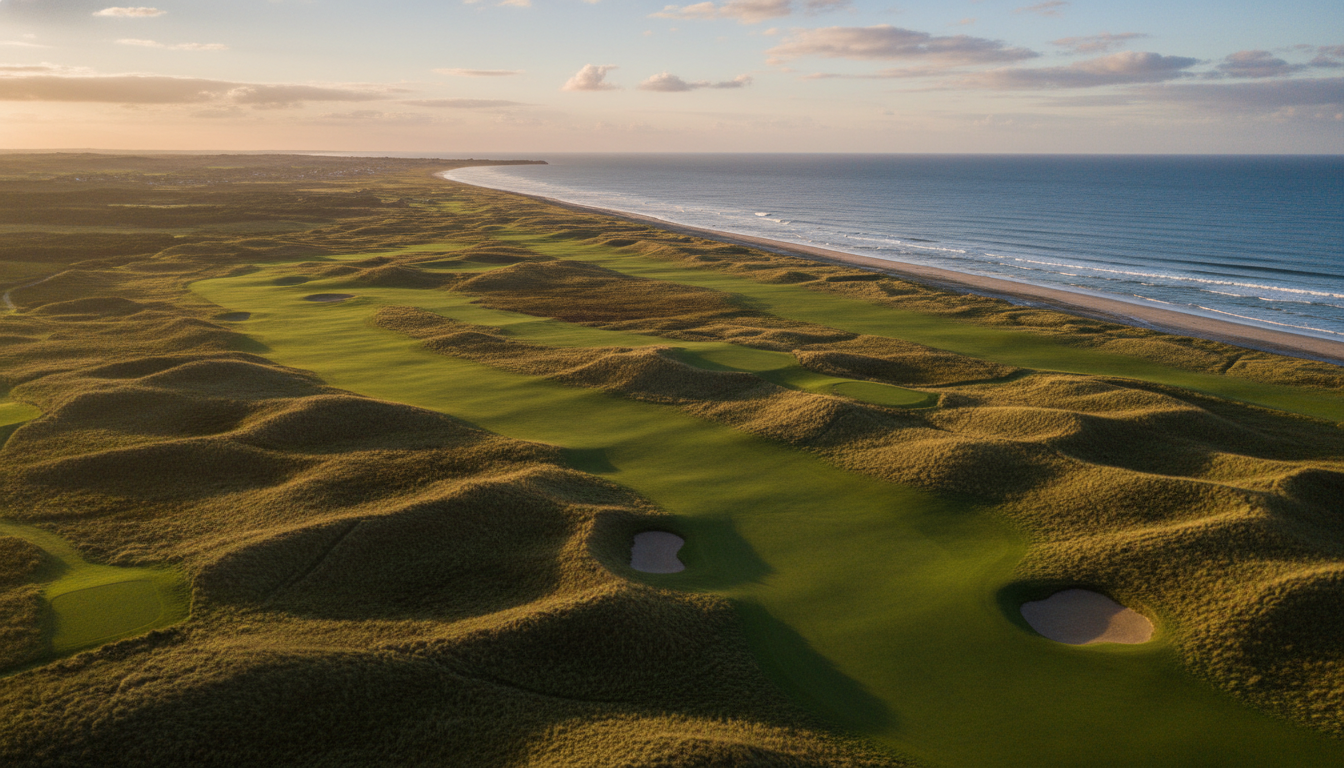



Where the Mountains of Mourne cascade toward Dundrum Bay, Royal County Down presents golf in its most elemental form. This isn’t the manicured perfection of Augusta or the manufactured drama of desert golf. This is raw, ancient linkland where gorse blazes yellow against purple heather, where blind shots demand faith rather than certainty, and where the landscape itself becomes the architect’s most powerful weapon. Consistently ranked among the top three courses on the planet, Royal County Down stands as testament to the idea that golf’s greatest architecture often requires the least interference with nature’s original canvas.
The first glimpse stops most visitors cold. Slieve Donard, the highest peak in Northern Ireland, rises 2,790 feet directly behind the clubhouse, its granite mass dominating the horizon. The fairways roll and tumble through dunes that were shaped by wind and tide over millennia, not by bulldozers and modern earthmovers.
History and Design
Old Tom Morris laid out the original eighteen holes at Royal County Down in 1889, receiving the princely sum of four pounds for his efforts. Morris routed the course across duneland that locals had used for grazing and informal golf for years, creating a layout that worked with the natural contours rather than fighting them. George Combe refined the design in 1904, and Harry Vardon made further modifications in 1908, but the essential character Morris established remains intact.
The club received its royal designation in 1908 from King Edward VII, joining the exclusive ranks of royal golf clubs throughout the British Isles. Major updates came in the 1920s and 1930s, but Royal County Down has largely resisted the temptation to modernize or soften its challenges. The course measures 7,186 yards from the championship tees, though yardage tells only a fraction of the story here.
Course Layout and Signature Holes
Royal County Down plays as a par 71, split evenly with a front nine of 3,486 yards and a back nine of 3,700 yards. The opening hole, a 538-yard par 5, immediately establishes the course’s character with a drive over wild dunes to a fairway you cannot see from the tee. Trust the line painted on the stone marker, commit to the shot, and accept that blind golf is fundamental to the Royal County Down experience.
The 4th hole, “Bobby Locke,” stretches 217 yards and plays as one of the world’s great par 3s. Your tee shot must carry a vast wasteland of gorse and heather to reach a green protected by deep bunkers. When the wind blows from the Irish Sea, even perfect strikes can come up short in the tangled rough.
The greatest sequence arrives at holes 4 through 9, a stretch that many consider the finest six consecutive holes in golf. This run includes the dramatic downhill par 3 7th at 145 yards, where the green sits in an amphitheater of dunes with Slieve Donard looming behind. Miss the putting surface here, and you’ll understand why Royal County Down demands precise iron play above all else.
Here’s a detailed look at this legendary stretch of holes:
The back nine presents a different character, turning inland and away from the sea for several holes before returning to the dunes. The 13th, a 443-yard par 4, requires a blind drive followed by an approach to a plateau green with no margin for error. The finishing holes build drama steadily, with the par 4 18th playing 547 yards back toward the clubhouse with the mountains framing every shot.
What Makes It World-Class
Royal County Down earns its lofty ranking through an uncompromising commitment to natural golf architecture. This course doesn’t apologize for blind shots, punishing rough, or narrow driving corridors flanked by gorse that swallows golf balls like quicksand. The design philosophy here holds that great golf should test nerve and imagination as much as technical skill.
The green complexes set Royal County Down apart from lesser links courses. These putting surfaces feature subtle contours and false fronts that reject anything less than precisely struck approach shots. Greenside bunkering is strategic rather than decorative, positioned to catch the mishit rather than simply frame the target.
The visual aesthetic contributes significantly to the course’s greatness. The yellow gorse blooms create color contrasts that photographers dream about, while the ever-present mountain backdrop provides perspective and scale. Royal County Down looks like the Platonic ideal of links golf, the course that non-golfers imagine when they picture Scottish or Irish seaside golf.

Get the Edge on Every Tournament
AI-powered predictions, data-driven analysis, and expert picks delivered before every PGA Tour event.
Try Golf Agent ProPlaying Experience
Playing Royal County Down feels like stepping into golf’s past, when courses tested players through strategy and course management rather than pure distance. The experience begins in the understated clubhouse, where tradition holds sway but stuffiness stays checked at the door. Members and visitors share the same respect for the sacred ground beyond the first tee.
The caddies here prove invaluable, not merely for yardages but for reading the wind, explaining blind shots, and sharing stories about legendary rounds played over this turf. Local knowledge matters immensely at Royal County Down. The caddie will point out the aiming posts on blind holes, suggest the conservative line when gorse threatens, and explain which greens can be approached from the sides versus those demanding aerial attacks.
Conditioning at Royal County Down emphasizes firm, fast playing surfaces that reward precision and penalize wayward shots. The fairways run firm enough that well-struck drives can gain extra yardage, but they’re also narrow enough that missing them by even a few yards often means a lost ball in the gorse. The rough here doesn’t just penalize, it destroys scoring potential.
This comprehensive walk through every hole captures the full Royal County Down experience:
The video showcases how each hole presents unique challenges while maintaining the course’s cohesive design philosophy.
The wind remains the ultimate variable. A calm morning can transform into a three-club breeze by afternoon, completely altering the course’s character. Par becomes an outstanding score when the wind howls off Dundrum Bay, turning approach shots into guessing games and making the already-demanding greens nearly unreachable.
Notable Tournaments and Moments
Royal County Down has hosted numerous significant amateur championships, including the British Amateur in 1970 and again in 1999, plus multiple Irish Opens. The 2007 Walker Cup brought international attention, with Great Britain and Ireland defeating the United States 12.5 to 11.5 in a dramatic match played before enthusiastic crowds.
Despite its world-class status, Royal County Down has never hosted a major professional championship. The course’s traditional layout, with several blind shots and limited space for modern tournament infrastructure, makes hosting large-scale professional events challenging. Some purists argue this works in the course’s favor, preserving its authentic character without the modifications that major championships often demand.
Rory McIlroy, Northern Ireland’s golf superstar who grew up just miles from Royal County Down, has called it his favorite course in the world. He has played countless rounds here since childhood, developing the shot-making skills and links golf acumen that would later translate to major championship victories.
Tom Watson famously declared Royal County Down the finest links he had ever played. Coming from the five-time Open Championship winner who conquered Turnberry, Carnoustie, and Muirfield, that assessment carries considerable weight. Tiger Woods has similarly praised the course, calling it a true test of shotmaking and imagination.
Visitor Information
Royal County Down operates as a private members club but welcomes visitors on specific days and times throughout the season. Full booking details and tee time availability are on the official Royal County Down website. Green fees for the Championship Course run approximately 280-320 pounds depending on the season, placing it among the more expensive rounds in Ireland and the United Kingdom but still more accessible than many top American private clubs.
Tee times for visitors are typically available Monday through Friday, with restrictions on weekends when members have priority. Booking well in advance is essential, particularly during peak summer months when demand far exceeds available slots. The club requires proper golf attire and maintains traditional standards, though the atmosphere remains welcoming rather than intimidating.
The best time to visit runs from May through September when daylight extends deep into evening and weather conditions are most favorable. That said, Royal County Down in spring or autumn offers spectacular golf with fewer crowds and the added drama of changeable weather. The gorse blooms brightest in late spring, creating the most photographically stunning conditions.
Newcastle, the adjacent town, offers accommodation ranging from the historic Slieve Donard Resort & Spa, which sits directly beside the course, to more modest bed and breakfasts. The location in County Down positions visitors perfectly for exploring Northern Ireland’s other golfing treasures, including Royal Portrush an hour north and the links courses of the Causeway Coast.
Nearby alternatives worth exploring include Ardglass Golf Club, a dramatic clifftop course just 15 minutes away, and Kirkistown Castle Golf Club, which offers excellent links golf at significantly lower green fees. For those unable to secure a tee time at Royal County Down’s Championship Course, the club’s Annesley Course provides a worthy consolation, playing through similar duneland with many of the same views.
The Verdict
Royal County Down belongs on every serious golfer’s bucket list, full stop. This is golf architecture at its purest and most dramatic, where natural landforms create challenges that no modern designer could replicate, much like how Cypress Point Club delivers dramatic seaside golf on California’s rugged coastline. Anyone who appreciates links golf, dramatic scenery, and courses that demand strategy over brute force will find their golfing pilgrimage rewarded at Royal County Down, similar to the experience at Pine Valley Golf Club, another masterpiece that tests nerve and imagination in equal measure.
Looking for an edge on the PGA Tour? Golf Agent Pro delivers AI-powered insights for every tournament.
Frequently Asked Questions
- Where is Royal County Down golf course located?
- Royal County Down is located in Newcastle, County Down, Northern Ireland, along Dundrum Bay at the foot of the Mountains of Mourne. The course sits approximately 30 miles south of Belfast.
- How much does it cost to play Royal County Down?
- Green fees at Royal County Down typically range from £200-£295 for visitors during peak season, depending on the day and time. Prices are lower in shoulder seasons, and the course requires advance booking as tee times are limited for non-members.
- Why is Royal County Down ranked so high?
- Royal County Down consistently ranks in the world's top three courses due to its dramatic natural duneland, stunning mountain backdrop, and Old Tom Morris routing that requires minimal artificial interference. The combination of challenging blind shots, natural hazards, and raw links character creates an unforgettable golf experience.
- What is the best time of year to play Royal County Down?
- May through September offers the most reliable weather and longest daylight hours at Royal County Down. Spring (April-May) features vibrant gorse blooms, while autumn (September-October) provides fewer crowds and dramatic lighting, though weather becomes more unpredictable.