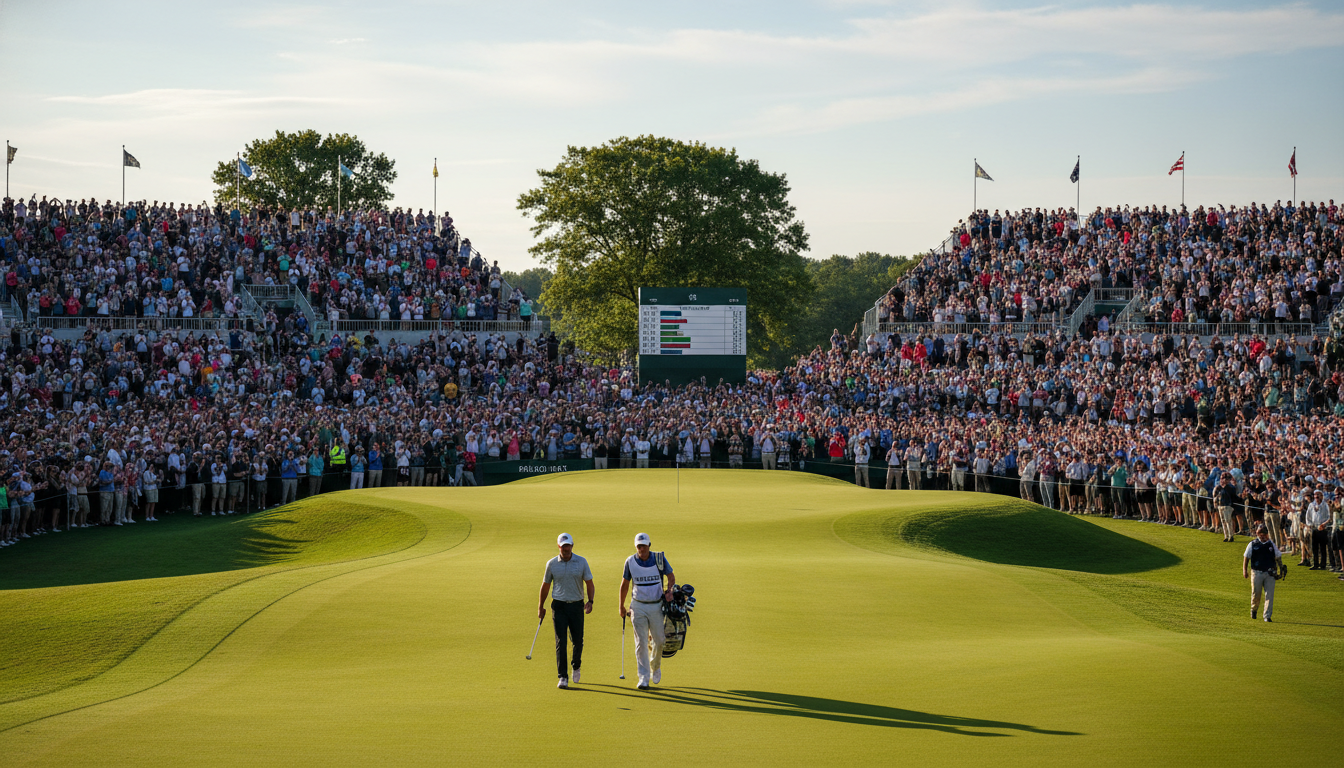



The 2026 Truist Championship heading into the weekend presents one of the more intriguing betting landscapes we’ve seen this season at Quail Hollow. Sungjae Im leads at -9 after firing a brilliant 64 in R1, while Tommy Fleetwood sits one back at -8. What makes this weekend compelling is how dramatically the DataGolf model’s probabilities have shifted compared to the sportsbook odds - and where the real value might be hiding behind some surprising R1/R2 performances.
As our Wednesday preview noted, this course was setting up for ball-strikers who could navigate challenging approach angles in potentially brutal weather conditions. After two rounds, we’re seeing exactly that play out in the strokes gained data, which creates some fascinating betting angles for the weekend.
This Week’s Betting Landscape
Tommy Fleetwood sits as the betting favorite at +325 on DraftKings despite trailing Im by one shot, which immediately tells you the market doesn’t fully trust Im’s recent form or course history. Sungjae Im is +670, while Rory McIlroy - sitting five shots back at -5 - is still +580, reflecting the market’s belief that his ball-striking upside could close that gap quickly.
Justin Thomas at +820 looks interesting given his position at -7 and strong R1/R2 performance. What jumps out to me is how compressed the odds are between positions 3 through 8 on the leaderboard. Nicolai Hojgaard at +1325 and Cameron Young at +1300 are getting similar prices despite Young’s superior baseline strokes gained profile.
Alex Fitzpatrick at +1550 represents an intriguing sleeper - he’s gained +2.33 strokes on approach through 36 holes, which is exactly the skill that wins at this track. The longshot board features some wild variance, with players like Rickie Fowler (+2000) and Harris English (+2300) sitting at -5 but getting 20-1 and 23-1 odds respectively.
Value Plays: Where the DataGolf Model Disagrees
The most glaring discrepancy is Tommy Fleetwood. The DataGolf model gives him a 17.9% win probability, which converts to roughly +458 in implied odds. The sportsbook has him at +325 (23.5% implied). That’s not value - that’s the market overreacting to his second-place position and smooth R2 67.
Conversely, Rory McIlroy at +580 (14.7% implied) looks like legitimate value when the model assigns him a 12.8% win probability (+682 fair odds). He’s gained +1.46 strokes off-the-tee and +1.42 on approach through two rounds - exactly his game profile. Five shots back is nothing for Rory’s ceiling, and I think this number underestimates his weekend scoring ability at a course where he’s got strong history (+0.36 course history adjustment in the model).
Cameron Young represents massive value at +1300 (7.1% implied) when the DataGolf model assigns him a 5.6% win probability, but here’s the twist - that 5.6% is his UPDATED probability after struggling to -4 through R2. His pre-tournament baseline was 8.2%, suggesting the model believed in him significantly more before the event started. At +1300, I’m not buying that he suddenly can’t find his game on a weekend. He’s gained +0.74 strokes OTT and +1.45 around the green - the short game scrambling keeps him alive.
The video above breaks down the pre-tournament odds structure that framed this week’s betting market. What’s changed dramatically is how R1/R2 performances have reshuffled the value equation.
Alex Fitzpatrick at +1550 (6.1% implied) versus the model’s 5.4% probability looks fairly priced on the surface, but dig into his strokes gained splits and you’ll see why he’s dangerous. His +2.33 SG:APP through two rounds is second-best in the field, and he’s hitting 77.8% of greens. At Quail Hollow, approach play is the primary predictor of success - if he can clean up the putting (-0.24 SG:PUTT), he’s got multiple scoring clubs in the bag.
The most fascinating longshot discrepancy is Rickie Fowler. At +2000 (4.8% implied), the sportsbooks are giving him half the respect the model shows (3.5% win probability, +2757 fair odds). But look at his R2 performance - he shot 63 after opening with 74, gaining +1.74 strokes on approach in that second round. That ball-striking variance is vintage Fowler, and at this price, I like the upside if he brings the R2 version on the weekend.

Get the Edge on Every Tournament
AI-powered predictions, data-driven analysis, and expert picks delivered before every PGA Tour event.
Try Golf Agent ProStrokes Gained Breakdown
The live tournament data through R2 reveals exactly which skills are separating the contenders from the field this week. Sungjae Im leads the field in total strokes gained at +4.14, but his profile is remarkably balanced - +1.10 OTT, +1.06 APP, +0.95 ARG, and +1.03 putting. He’s not dominating any single category, just doing everything well.
Tommy Fleetwood’s +3.64 total is built almost entirely on putting (+2.12 SG:PUTT), which raises red flags for sustainability. His approach play is solid at +0.61, but he’s been average off-the-tee (+0.21). When you compare that to his baseline strokes gained profile (career SG:OTT +0.513, SG:APP +0.515), he’s performing right at expectation everywhere except the putter - which means reversion to the mean could hurt him on the weekend.
Rory McIlroy’s strokes gained splits show exactly why the model still believes in him despite sitting five back. He’s gained +1.46 OTT and +1.42 APP through two rounds - that’s elite ball-striking. The problem has been his short game (-0.36 ARG) and putting (-0.38), both of which are significantly below his baseline capabilities. If those categories normalize to even neutral over the weekend, he’s going to pile up birdies.
Justin Thomas at -7 has gained +1.35 strokes putting and +0.89 around the green - this is a scoreboard-centric performance, not a ball-striking clinic. His approach play is just +0.22, which is well below his baseline SG:APP of +0.999. That suggests he’s getting away with scrambling and hot putting rather than controlling the golf course, which makes him vulnerable if those putts stop falling.
Alex Fitzpatrick’s +2.33 SG:APP is the story of his week. He’s hitting 77.8% of greens and controlling his distances beautifully. The -0.24 putting is keeping him from being closer to the lead, but statistically, that’s likely to improve - his putter has been solid this season overall. Cameron Young’s splits tell a different story - he’s gained just -0.84 on approach, well below his elite baseline, but he’s salvaged rounds with +1.45 around the green. That scrambling ability is keeping him in the hunt.
R1/R2 Recap and Weekend Storylines
The R1/R2 performances at Quail Hollow have reshaped the betting board in ways that create clear weekend angles. Sungjae Im’s opening 64 was no fluke - he followed it with a steady 69 to maintain the solo lead at -9. His 72.2% greens in regulation rate and 71.4% driving accuracy show he’s playing mistake-free golf and avoiding Quail Hollow’s notorious trouble spots.
Tommy Fleetwood’s consecutive 67s position him perfectly, but as our live golf betting strategy guide highlighted, R1 leaders who rely heavily on putting often face challenges maintaining that edge over 72 holes. Fleetwood’s +2.12 SG:PUTT is masking mediocre ball-striking relative to the elite players in the field.
The cut fell at +3, which meant we lost some pre-tournament favorites to disappointing weekends. Matt Fitzpatrick barely made it through at +2 after rounds of 74-68, gaining just -0.24 strokes total through 36 holes. Xander Schauffele at even par scraped through but is now 9 shots back and essentially out of realistic win contention. Viktor Hovland also sits at even par after struggling to find consistency.
The most volatile R1/R2 performances came from players who couldn’t sustain momentum. Rickie Fowler went 74-63, a 11-shot swing that speaks to both his current inconsistency and his scoring ceiling. Matt McCarty did the reverse - 63-74 - which drops him from contention but shows he’s capable of a nuclear round if everything clicks. Those boom-or-bust profiles make for tricky weekend betting decisions.
Rory McIlroy’s 70-67 progression suggests he’s found something with his game after a slow start. His SG:OTT and SG:APP numbers through R2 match his elite baseline, which means he’s playing his A-game tee-to-green. Five shots back is manageable for a player of his caliber if the putter cooperates.
Justin Thomas and Alex Fitzpatrick both sitting at -7 represent different paths to contention. Thomas has scrambled his way there with short game magic, while Alex Fitzpatrick has striped it tee-to-green. I trust the Fitzpatrick model more for sustainability over the weekend - ball-striking holds up under pressure better than hot putting.
Matchup Analysis
The weekend pairings provide some exploitable matchup edges where the DataGolf model sees clear separation from the sportsbook lines.
Hideki Matsuyama (-136 model, -140 sportsbook) versus Mackenzie Hughes (+207 model, +150 sportsbook) is one where the books are giving Hughes too much credit. Matsuyama’s baseline SG:Total of +1.31 dwarfs Hughes, and his approach play (career +0.687 SG:APP) is exactly what wins at Quail Hollow. The sportsbook line of -140/+150 doesn’t reflect the true talent gap here - I see this closer to -160 fair value.
Adam Scott (-171 model, -170 sportsbook) versus Webb Simpson (+263 model, +187 sportsbook) shows interesting alignment. Both the model and the books agree Scott is the right side, which often means the market has properly identified the edge. Scott’s baseline SG:APP of +0.809 gives him a significant advantage on a course where approach play dominates. What concerns me slightly is his recent missed cut, but at -170, there’s not much value to extract here anyway.
The most interesting contrarian matchup is Jason Day (+141 model) versus Robert MacIntyre (+108 model). The sportsbook prices suggest these players are essentially even, but the DataGolf model gives Day a slight edge. MacIntyre’s recent form has been solid (+1.489 SG:Total baseline), but he’s actually LOST strokes at Quail Hollow through R2. Day’s +1.238 baseline is slightly lower, but if you believe in model edges, this is a spot where you’re getting Day at a better number than his true win probability.
Daniel Berger (-145 model) versus Brian Campbell (+219 model) is another where the books (-150/+180) are fairly efficient. Berger’s higher baseline skill rating gives him the clear edge, and there’s no exploitable model disagreement here - pass on this matchup unless you have specific recent form reads.
Key Stats to Watch
Approach play continues to be the most predictive stat for Quail Hollow success. Through R2, the top-10 players on the leaderboard are averaging +0.84 SG:APP, while the field average is closer to +0.15. Alex Fitzpatrick’s +2.33 leads the contenders, followed by Rickie Fowler’s +1.74 and Sepp Straka’s +1.43. If you’re betting a player who isn’t gaining significant strokes on approach, you’re betting on short game variance - which is inherently less stable.
Driving accuracy matters more than driving distance at this track. The live stats show that players hitting 70%+ of fairways are scoring 1.8 strokes better per round than those below 60%. Corey Conners leads the field at 85.7% accuracy, while Harris English and Harry Hall are both at 75%. Rory McIlroy’s 50% accuracy hasn’t killed him yet because his iron play is so elite, but that margin for error shrinks on the weekend when pins get tucked.
Scrambling percentage is the hidden stat that’s keeping several players alive. Tony Finau is hitting just 55.6% of greens but scrambling at 70.8%, which is the only reason he’s at -3. Matt McCarty’s 53.3% scrambling rate is why his 63 in R1 was followed by a 74 - when he missed greens, he couldn’t save par. For weekend betting, target players who both hit greens AND scramble well when they miss - that’s how you avoid blow-up holes.
Putting on Quail Hollow’s bentgrass greens is creating huge scoring variance. The leaders in SG:PUTT through R2 are Matt McCarty (+2.40), David Lipsky (+2.29), and Nick Taylor (+2.19) - none of whom are particularly known as elite putters baseline. That’s regression risk right there. Conversely, Ludvig Aberg has LOST -0.92 strokes putting despite being one of the better putters on tour this season - he’s due for positive regression if you believe in skill-based mean reversion.
The course breakdown video above provides critical context for understanding which holes are creating the most separation this week. Through R2, Hole 7 (par-4, 497 yards) is playing as the hardest at 4.597 strokes average, with players making just 35 birdies against 28 pars and 8 bogeys. That’s a scoring hole that’s playing brutally tough, which means weekend positioning on the back nine becomes critical for making a move.
Get the Full Breakdown
The weekend at Quail Hollow is setting up for a fascinating finish with multiple players holding legitimate win equity based on both form and course fit. The DataGolf model’s updated probabilities after R2 reveal several pricing inefficiencies compared to the sportsbook odds, particularly with Rory McIlroy’s value at +580 and Cameron Young’s longshot appeal at +1300. For complete model-driven picks using strokes gained analytics that predict PGA Tour winners, detailed matchup edges, and real-time probability updates throughout the weekend, check out Golf Agent Pro for the full betting breakdown and expert analysis.