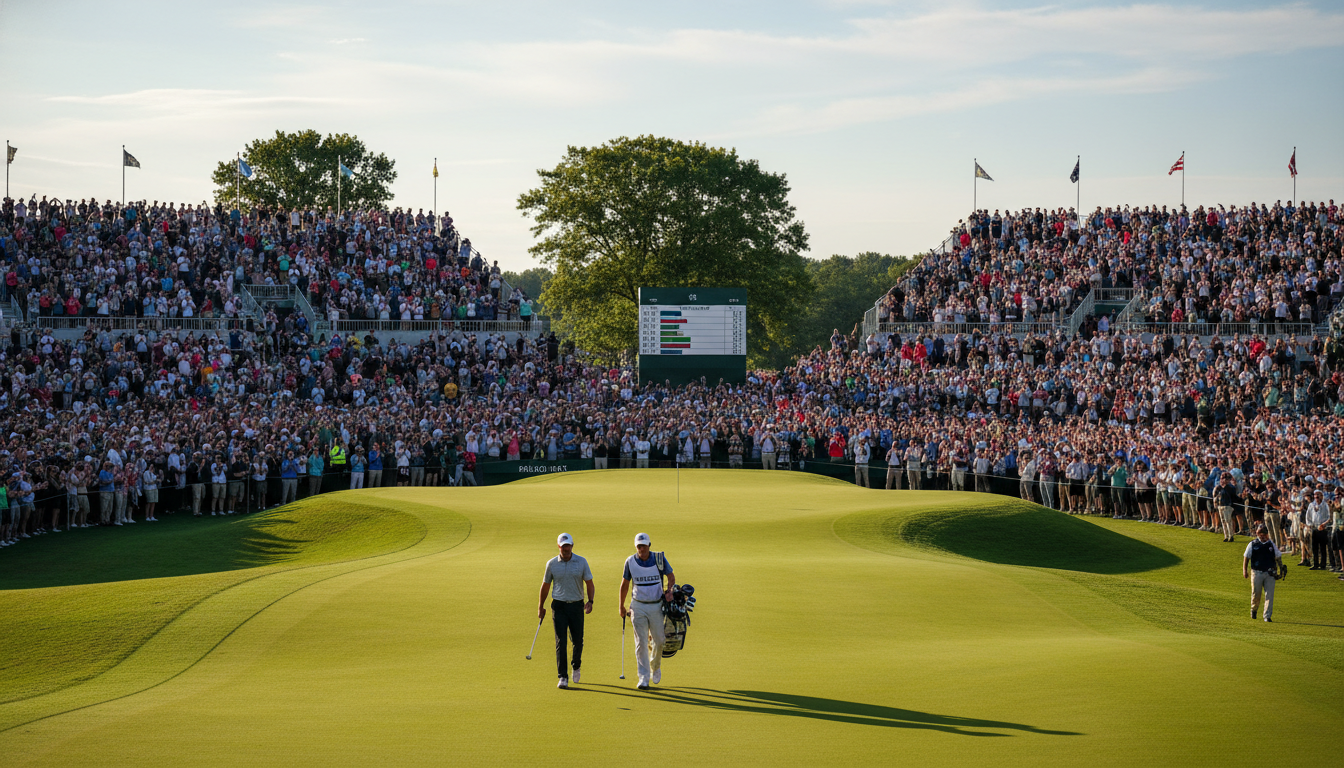


Rory McIlroy is doing what Rory McIlroy does at Augusta National when he’s rolling - and that six-shot lead after a Friday 65 has completely reshuffled the Masters betting board heading into the weekend. The Northern Irishman sits at -12 after posting a combined +7.75 strokes gained total through 36 holes, while the chase pack at -6 and -5 is trying to figure out how to make up ground on a player who gained 2.74 strokes on approach and 2.32 on the greens this week. As our Wednesday preview noted, this Augusta National setup was always going to favor iron players who could take advantage of softer conditions, and Rory has done exactly that.
This Week’s Betting Landscape
The odds tell the story of Rory’s dominance. He opened the week around +900 on DraftKings and is now sitting at -250 to win his first green jacket. That’s a massive favorite for a 36-hole lead at any major, but the DataGolf model actually has him even higher at 69.2% win probability. When you see a player trading at those implied odds, you’re looking at a potential runaway.
Behind Rory, the betting market is pricing Tommy Fleetwood at +1800 (DataGolf model: 4.4% win probability), Sam Burns at +2100 (4.4%), and Patrick Reed at +1500 (3.4%). What jumps out to me is that the sportsbooks are giving Fleetwood and Burns identical model win equity despite Fleetwood being nearly 300 points longer. That’s the kind of discrepancy that makes you look closer at the underlying performance data.
Shane Lowry sits at +3400 on DraftKings despite the DataGolf model only giving him a 1.7% win chance. That number feels inflated by his T4 position at -5, but his path to victory requires making up seven shots on a player who has gained strokes in every major category this week. I’m not buying that at 34-1 when the model sees less than a 2% edge.
Value Plays: Where the DataGolf Model Disagrees
Let’s start with Cameron Young at +2500 on DraftKings vs a 3.4% DataGolf model win probability. Young gained a massive 1.96 strokes off the tee through two rounds and sits T7 at -4. The model conversion suggests fair value is closer to +2837, making the posted DraftKings price slightly favorable when you factor in vig. Young’s ball-striking (1.39 SG:APP, 0.23 SG:PUTT) fits Augusta perfectly when he’s driving it this well.
Patrick Reed at +1500 looks shorter than it should be given his 3.4% model win equity. The implied probability from those DraftKings odds is roughly 6.3%, and while Reed has been here before (he won the 2018 Masters), his R1/R2 performance shows some holes. He gained 2.23 strokes putting but only 0.80 on approach - that’s not a sustainable formula to chase down Rory over the weekend.
Tommy Fleetwood at +1800 vs 4.4% model probability is where I think real value exists. His +2.56 strokes gained putting through 36 holes is elite (63.9% GIR, 85.7% fairways), and his course history at Augusta is strong with multiple top-5s. The model sees him and Burns as nearly identical win chances, but you’re getting better odds on Fleetwood. That’s the kind of market inefficiency I like.
Xander Schauffele at +6900 (1.5% model) is interesting purely because of the ball-striking (2.25 SG:APP, 1.56 SG:OTT). The putting has been neutral (-0.04 SG:PUTT) and the short game cost him (minus-1.02 SG:ARG), but if he can clean up the wedges on the weekend, there’s a path to a big move. I’m not saying bet it - but the model sees more equity than the 1.4% implied by those FanDuel odds.
Brooks Koepka at +5900 vs a 1.0% model probability looks like the books are pricing in his major championship pedigree rather than his actual performance this week. He gained 2.16 strokes on approach (strong) but his off-the-tee play has been mediocre (0.23 SG:OTT). At -3, he needs a weekend miracle to catch Rory, and the model doesn’t see it happening even 1% of the time.
Strokes Gained Breakdown
Augusta National is revealing exactly what we expected - approach play and putting are separating the field. Let’s look at what the top performers are doing this week compared to their baseline skill levels, using strokes gained metrics that predict PGA Tour performance.
Rory McIlroy’s 2.74 strokes gained on approach through two rounds is nearly four times his season average of 0.687 SG:APP. That’s elite iron play on a course where precision matters more than most. His 2.32 SG:PUTT is equally impressive when you consider his career baseline of 0.3. When Rory is both striking and putting at this level, he’s borderline unbeatable.
Shane Lowry’s 2.97 SG:APP is the highest in the field through 36 holes, and his 83.3% GIR rate backs it up. Lowry is historically not a strong putter (career 0.061 SG:PUTT), but he’s gained 0.61 on the greens this week. For context, our Round 1 recap highlighted how early-round putting variance can shift weekend positioning, and Lowry is a perfect example of neutral putting being enough when your irons are this dialed.

Get the Edge on Every Tournament
AI-powered predictions, data-driven analysis, and expert picks delivered before every PGA Tour event.
Try Golf Agent ProTommy Fleetwood’s performance profile is almost the inverse. He’s gaining 0.98 SG:APP (below Rory and Lowry) but absolutely printing on the greens with 2.56 SG:PUTT. That 85.7% driving accuracy is giving him clean looks at flagsticks, and when he’s this confident with the flatstick, he can make up for slightly lesser approach proximity.
What concerns me about Sam Burns is the sharp drop from R1 to R2. He posted a 67-71 and his putting fell off (1.06 SG:PUTT is solid but not elite). His 83.3% GIR rate suggests the ball-striking is there, but if the putter cools further on the weekend, he’s going to struggle to make up shots on players ahead of him.
Wyndham Clark and Tyrrell Hatton are both sitting at -4 with nearly identical strokes gained profiles (1.31 vs 1.37 SG:OTT, 1.64 vs 1.46 SG:APP). The difference is both are losing strokes on the greens (minus-0.58 and minus-0.44 respectively). Neither has putted well at Augusta historically, and asking them to suddenly find something with the flatstick while chasing Rory feels optimistic.
Scottie Scheffler’s even-par position through 36 holes is stunning given his ball-striking (1.94 SG:OTT, 0.33 SG:APP). He’s lost a full 1.20 strokes putting, which is the worst mark among players inside the top 25. Scottie’s career baseline is 0.567 SG:PUTT - when he’s losing that much on the greens, even the world number one can’t overcome it.
Matchup Analysis
The Saturday pairings give us some interesting spots where the DataGolf model disagrees with the sportsbook pricing. Let’s dig into a few that stand out.
Scottie Scheffler (-124) vs Ludvig Aberg (+186) in the 12:16 tee time is where I think the market is pricing Scottie’s reputation over his current form. The DataGolf model has Scheffler at -137 vs Aberg at +137, which is tighter than the DraftKings line suggests. Aberg is even-par like Scottie but has actually putted slightly better (0.338 SG:PUTT career vs Scottie losing 1.20 this week). If Scottie’s putter stays cold, Aberg has the ball-striking to win this pairing outright.
Patrick Cantlay (-115) vs Viktor Hovland (-105) is the late morning pairing where I actually like Hovland as a small dog. The sportsbook has this nearly even, but the DataGolf model sees Cantlay at +100 vs Hovland at -100 (slightly favoring Viktor). Hovland missed the cut last year but gained 0.605 SG:OTT and 0.554 SG:APP through his career baseline. Cantlay’s advantage is experience, but when the model likes the underdog, I’m paying attention.
Si Woo Kim (+173) vs Jon Rahm (-115) looks like a massive mismatch on paper, but the DataGolf model has this at -158 vs +158 (not quite as wide). Rahm is at even-par and clearly struggling with something (he shot 78 in R2). Si Woo Kim is coming off a 74-74 week and missed the cut, so this is more of a “fade Rahm at this price” angle than a “bet Si Woo” one. But the model sees more of a fight than the bookmakers do.
R1/R2 Recap and Weekend Storylines
Rory McIlroy’s 67-65 start ties the best 36-hole performance at Augusta this decade, and his six-shot lead is the largest at this stage since Jordan Spieth’s 2015 wire-to-wire victory. The key number through two rounds is his 72.2% GIR combined with gaining over two strokes putting - when those two stats align at Augusta, it’s historically been enough to hold big leads.
The surprise of the week has been Justin Rose sitting T4 at -5. Rose hasn’t won on tour since 2019, but his 2.73 SG:APP through 36 holes shows the iron play that made him a Masters runner-up in 2017. His 77.8% GIR and 78.6% driving accuracy are both elite marks, and at age 43, he’s proving that Augusta course history (he’s finished top-20 here in seven of his last ten starts) matters more than current form.
Patrick Reed at -6 is another name that fits the Augusta profile. Reed won here in 2018 and finished T4 in 2023, and his short game (0.86 SG:ARG this week) is giving him birdie chances even when he misses greens. His 75% scrambling rate is second-best among the top ten, and that kind of Houdini golf can manufacture rounds in the 60s when conditions get tricky on the weekend.
The cut line came at +3, which sent home some notable names. Jon Rahm’s difficult week was shocking for a player of his caliber - he gained just 0.808 SG:OTT and 0.847 SG:APP, miles below his career baseline of 2.257 SG:Total. Bryson DeChambeau also missed (details not provided in leaderboard), which removes another big bomber from contention.
Scottie Scheffler surviving at even-par despite losing 1.20 strokes putting is both impressive and concerning. The ball-striking baseline is there (1.94 SG:OTT this week vs 0.705 career), but if he can’t find something with the putter on the weekend, he’s not making up seven shots on Rory.
Cameron Young’s 73-67 Friday surge moved him to T7 at -4, and his weekend tee time puts him ahead of Rory on the course. Young gained 1.96 strokes off the tee (89.3% accuracy) and 1.39 on approach, which is the exact formula Augusta rewards. His 0.23 SG:PUTT is neutral, but when you’re hitting it this pure from tee to green, you don’t need to make everything.
Key Stats to Watch
Approach play from 150-175 yards is going to determine the weekend. Augusta’s scoreability comes from wedge and short iron precision, and players gaining strokes in that proximity band are the ones posting red numbers. Rory’s 2.74 SG:APP leads the field, but Shane Lowry (2.97) and Justin Rose (2.73) are right there. If either of them gets hot on Saturday, they can apply pressure.
Putting on Bermuda greens under pressure is the great Masters separator. The weekend pins will be tucked, the greens will firm up slightly, and players who can make the 8-12 footers for par are the ones who stay in contention. Tommy Fleetwood’s 2.56 SG:PUTT through two rounds is the best mark among players in the top six, and that’s the kind of confidence you want heading into moving day.
Birdie conversion on the par-5s will dictate whether anyone can run down Rory. Holes 13 and 15 both played over 4.8 strokes average in R2 (toughest on the course), which means the easy birdies aren’t coming freely. Players who can get to those greens in two and convert will gain significant ground. Cameron Young’s driving distance (1.96 SG:OTT) gives him an advantage there.
Short game scrambling from Augusta’s false fronts is critical when players start pressing. The course setup is always punishing for missed greens, and we’re seeing that with Wyndham Clark (71.4% scrambling) and Tyrrell Hatton (72.7%) both losing strokes around the green despite strong GIR numbers. If they start missing more greens on the weekend and can’t get up and down, they’ll slip backward fast.
Get the Full Breakdown
The Masters weekend is set up perfectly for a Rory runaway or a Sunday charge from the players six shots back. If you want complete betting cards with model-driven picks, matchup analysis for every pairing, and real-time adjustments as the action unfolds, Golf Agent Pro has you covered for every PGA Tour event. We build the betting edges, you make the decisions.