
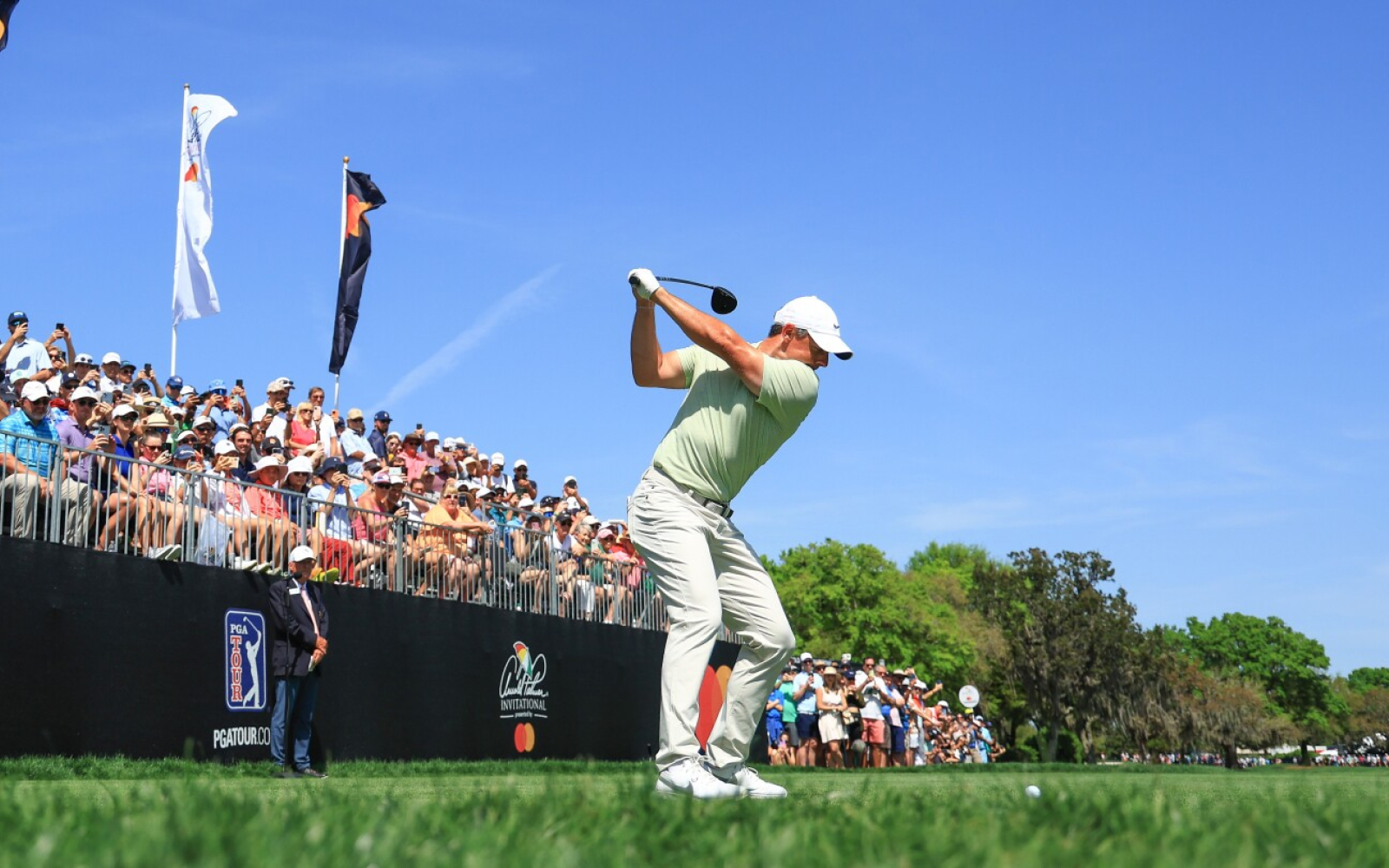
Daniel Berger fired a 9-under 63 on Thursday at Arnold Palmer’s Bay Hill Club & Lodge, seizing a three-stroke lead after Round 1 of the 2026 Arnold Palmer Invitational. Collin Morikawa and Ludvig Åberg sit tied for second at -6, while pre-tournament favorite Scottie Scheffler opened with an even-par 70 that left him seven shots back. I was surprised by how scorable Bay Hill played in the opening round - conditions that typically punish aggression instead rewarded precision ball-striking.
Round 1 Recap
Berger’s 63 represented a complete ball-striking clinic. He gained 3.77 strokes on approach and 3.74 strokes putting, combining elite iron play with a hot putter to dominate a course that typically yields few birdies. The 31-year-old made seven birdies and an eagle, hitting 12 of 18 greens and scrambling perfectly when he missed. His SG:Total of +8.81 was nearly three strokes better than anyone else in the field.
Morikawa and Åberg both posted 66s but got there differently. Morikawa gained 3.71 strokes on approach - consistent with his elite iron play profile - while Åberg leaned on off-the-tee performance (+1.20 SG:OTT) and putting (+2.98 SG:PUTT). Cameron Young joined Jhonattan Vegas at -5, with Young gaining a massive 2.38 strokes off the tee and hitting 16 of 18 greens.
The surprise struggles came from the favorites. Scheffler’s even-par 70 included just 11 greens in regulation, though he gained 1.82 strokes on approach - suggesting he hit quality iron shots that didn’t find the putting surface. Rory McIlroy also opened at even par, while Tommy Fleetwood withdrew before the round started. I think Scheffler’s position at -2 is less concerning than it appears - his ball-striking metrics suggest better scoring is coming.
What I found interesting was how the wind conditions softened Bay Hill’s usual teeth. Hole 6, typically one of the most demanding par-4s in Florida, played to a 4.708 average but yielded 29 birdies. The par-5 6th has historically been a birdie hole, but Thursday’s conditions made it even more accessible. Hole 12, the hardest hole of the day at 4.792, still surrendered one eagle.
Bryson DeChambeau’s aggressive play on Bay Hill’s long holes has historically defined tournament strategy. Thursday’s opening round showed a different template - precision over power, with Berger’s balanced gains across all categories proving most effective.
By the Numbers
The strokes gained data from Round 1 reveals why Berger leads by three. His +8.81 SG:Total came from balanced excellence - he ranked first in approach play (+3.77), first in putting (+3.74), and didn’t lose ground anywhere. That’s the profile of a player who can extend leads rather than protect them. Morikawa’s +5.81 SG:Total leaned heavily on approach (+3.71), while Åberg’s +5.81 came from a more balanced portfolio.
Cameron Young’s performance deserves attention. He gained 2.38 strokes off the tee and 2.00 on approach while hitting 16 of 18 greens - an 88.9% GIR rate that led the field among players posting scores under par. His accuracy (85.7%) and GIR percentage suggest he’s compressing the golf course in a way that typically correlates with weekend contention at Bay Hill. The DataGolf model moved him from 2.2% pre-tournament win probability to 7.2% after Round 1.
Chris Gotterup gained 3.36 strokes on approach - second-best in the field - but gave it all back with a horrific -1.55 putting day. He still posted 69 and sits at -3, but that putting performance creates volatility. If he finds even average form on the greens, he’s positioned for a weekend charge. The model gives him a 2.9% win probability, up from 1.9% pre-tournament.
Xander Schauffele’s 68 came via elite putting (+2.49 SG:PUTT) and around-the-green work (+1.18 SG:ARG). He gained just 0.04 strokes on approach and 0.10 off the tee, meaning his -4 position depends entirely on short game magic continuing. That profile typically regresses over 72 holes.
What surprised me most was Akshay Bhatia’s -2 score despite losing 2.95 strokes off the tee. He hit just 4 of 14 fairways (28.6% accuracy) but gained 4.78 strokes putting to salvage a 70. That’s not sustainable - the DataGolf model reflects this, giving him just a 0.7% win probability despite being T18.
Model vs. Reality
The DataGolf model’s pre-tournament projections for the Arnold Palmer Invitational identified Scottie Scheffler as a 15.7% win probability favorite, but his even-par 70 dropped him to 9.8% after Round 1. I was surprised the model remained that bullish on Scheffler despite the seven-shot deficit - it suggests his ball-striking metrics (especially the +1.82 SG:Approach despite missing seven greens) indicate better results coming.
Daniel Berger wasn’t in the pre-tournament top 20. The model gave him roughly 1.5% win probability before the week, and his 63 vaulted him to 14.1% - the biggest single-round model shift in the field. FanDuel moved his outright odds from +6000 pre-tournament to +540 after R1, the sharpest line movement of the day.
Collin Morikawa jumped from 2.7% pre-tournament to 10.7% after his 66. That’s the kind of model conviction I pay attention to - Morikawa gained strokes in the exact categories (approach play) that correlate with Bay Hill success. His +3.71 SG:Approach was second in the field, and understanding how strokes gained predicts PGA Tour winners helps explain why the model has such confidence in his position.
Cameron Young’s move from 2.2% to 7.2% win probability represents significant model conviction. DraftKings shifted his odds from +3500 to +1100, reflecting both his -5 position and the quality of his ball-striking. His 88.9% GIR rate in Round 1 is elite, and the model weighs that heavily in its projections.

Get the Edge on Every Tournament
AI-powered predictions, data-driven analysis, and expert picks delivered before every PGA Tour event.
Try Golf Agent ProRory McIlroy entered as the model’s second choice at 6.5% win probability but dropped to 2.9% after his even-par 70. BetMGM moved his line from +1200 to +2900 - the biggest odds inflation in the top tier. What I found interesting is that his ball-striking wasn’t disastrous (he gained 0.23 strokes on approach), but Bay Hill punishes putter struggles, and McIlroy lost 0.48 strokes on the greens Thursday.
Weekend Outlook
Bay Hill’s Friday and Saturday rounds typically play harder as pin positions tighten and greens firm up. Thursday’s scoring conditions were unusually soft - 17 players shot 69 or better, well above the historical average for opening rounds here. I think the cut line settles around +2 or +3, meaning Scheffler and the other even-par players have breathing room but can’t afford another mediocre round.
The course setup rewarded precision approach play in Round 1. Berger, Morikawa, and Gotterup all gained 3+ strokes on approach, while the players who relied on putting to score (Schauffele, Bhatia) created volatility in their profiles. Historically, Bay Hill winners gain strokes across all categories - the model’s continued faith in Scheffler despite his position suggests it expects his complete game to surface.
Wind conditions are forecast to increase Friday afternoon, which should tighten scoring spreads. The par-5 6th will become less accessible, and holes like 12 and 16 - which already played to 4.79 and 4.44 averages - will extract more penalty strokes. That benefits ball-strikers who avoid trouble over scramblers who rely on recovery shots.
What I’m watching this weekend is whether the leaders can maintain their approach play gains. Berger’s +3.77 SG:Approach is elite, but he’s historically been a streaky iron player. If he regresses even to his career average (+0.40 SG:Approach), that three-shot lead becomes vulnerable. Morikawa’s consistency with irons (career +0.928 SG:Approach) makes him the safer bet to sustain pressure.
Players to Watch
Cameron Young - His statistical profile after R1 is nearly perfect for Bay Hill. The 88.9% GIR rate and +2.38 SG:OTT suggest he’s controlling the golf course in ideal fashion. Young gained 2.00 strokes on approach while hitting 16 greens, a combination that historically correlates with weekend contention here. The DataGolf model moved him from 2.2% pre-tournament to 7.2% win probability, and BetMGM shifted his odds from +3500 to +1100 - the kind of market movement that reflects legitimate contender status.
Kurt Kitayama - The 2023 Arnold Palmer winner opened with a 69 and sits at -3, gaining 1.16 strokes off the tee and 0.63 on approach. His course history bonus in the DataGolf model (+0.02 course fit, +0.02 course history) adds confidence to his 3.5% win probability. What I like about Kitayama’s profile is the balanced strokes gained distribution - he didn’t rely on hot putting to score Thursday, which creates sustainability for 72 holes. Caesars moved his line from +8000 to +2600.
Chris Gotterup - Despite losing 1.55 strokes putting, Gotterup posted 69 and sits just four back. His +3.36 SG:Approach was second in the field, trailing only Berger. If he finds even field-average putting, he’s positioned for a charge. The model gives him 2.9% win probability (up from 1.9%), and DraftKings has him at +2900. The statistical profile is intriguing - elite approach play at a course that rewards iron precision.
Scottie Scheffler - Seven shots back feels distant, but the DataGolf model still gives him 9.8% win probability - higher than everyone except Berger, Morikawa, and Åberg. His ball-striking metrics suggest better scoring is coming. The +1.82 SG:Approach despite hitting just 11 greens indicates quality iron shots that didn’t convert - variance that typically corrects over 72 holes. FanDuel has him at +590, which represents the market’s ongoing respect for his complete game.
The model has identified three additional players with statistical profiles that outperformed their pre-tournament projections - patterns that historically correlate with strong weekend finishes. These profiles combine course fit advantages with Round 1 performance metrics that suggest edge opportunities.
Get the Full Analysis
For comprehensive strokes gained breakdowns, live model updates, and data-driven weekend projections, check out Golf Agent Pro. The app provides tournament-specific analysis for every PGA Tour event, helping you understand which statistical edges matter most as conditions evolve.