

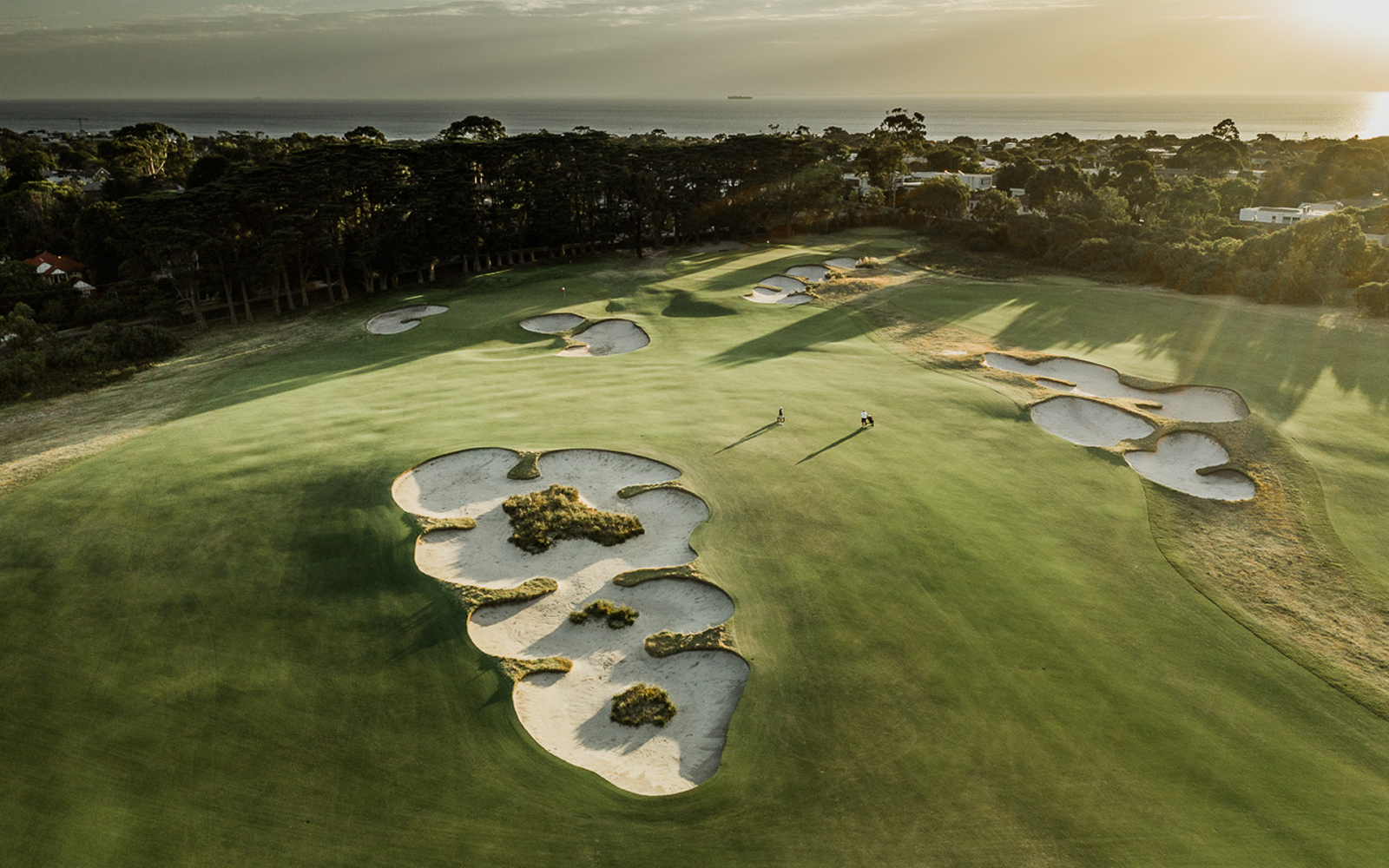
Standing on the first tee at Royal Melbourne’s West Course, I immediately understood why this layout consistently ranks among the world’s top ten golf courses. The rolling sandbelt terrain stretched before me, all golden fescue and dramatic bunkering, with putting surfaces that looked fast enough to test even the steadiest hands. What struck me most wasn’t the obvious beauty but the strategic complexity lurking in every angle, every contour, every seemingly innocent approach shot.
This is Dr. Alister MacKenzie at his absolute peak, working with material that suited his design philosophy perfectly. The sandy soil of Melbourne’s southeast allowed for crisp edges and firm conditions, while the natural undulations gave him a canvas most architects only dream about. I’d argue that Royal Melbourne West represents MacKenzie’s most complete work, even more cohesive than his celebrated collaboration at Augusta National.
History and Design
Royal Melbourne Golf Club traces its roots to 1891, making it Australia’s oldest continually existing golf club. The original club began in central Melbourne before multiple relocations finally brought it to the Black Rock property in the mid-1920s, settling on the famed Melbourne Sandbelt. This stretch of sandy soil south of the city would prove to be one of the world’s premier golf landscapes.
Dr. Alister MacKenzie visited the site in 1926 during his tour of Australia, and his routing for the West Course fit beautifully into the natural contours of the land. While MacKenzie provided the design blueprint, the actual construction was overseen by Australian golf champion Alex Russell and the club’s head greenkeeper, Mick Morcom, who proved instrumental in creating MacKenzie’s vision. The West Course opened for play in 1931 and immediately established itself as something special.
MacKenzie’s greens at Royal Melbourne are miniature versions of the surrounding topography, with slopes and undulations that echo the landscape. His bunkers feature the crisp, vertical edges that became his trademark, often standing a foot or more tall and chewing dramatically into fairways and putting surfaces. The construction techniques employed by Morcom, particularly the green complexes and bunker work, set standards that influenced Australian golf course architecture for generations.
Course Layout and Signature Holes
The West Course plays to a par of 72 and stretches approximately 6,500 yards from the championship tees, though yardage barely tells the story here. What makes this routing exceptional is how MacKenzie used angles and strategic options rather than length to create difficulty. Most holes dogleg at least slightly, meaning the ideal line into each green changes dramatically based on your tee shot placement.
The opening hole is a relatively gentle par 4 that quickly reveals the course’s philosophy: drive it to the correct side of the fairway or face a nearly impossible approach. The 3rd hole, a par 4 of just 333 yards, might be the most strategic hole on the property. I watched multiple groups debate whether to attempt the drive, only to see those who missed the narrow target area face brutal recovery shots.
The 5th hole, a 176-yard par 3, showcases MacKenzie’s genius with short holes. The green sits at a diagonal to the tee, heavily bunkered on the left, with the surface sloping away from the ideal entry point. The 6th, the famed “Dr. MacKenzie” hole, is a dogleg right par 5 where the fairway narrows dramatically at exactly the distance most players want to lay up. Three bunkers sit precisely where conservative play lands the ball, forcing a genuine strategic decision.
What I love about this routing is how the inward nine builds in intensity. The 12th plays slightly uphill to a green that appears simple until you realize how severely it slopes. The par-3 14th might be the finest short hole I’ve encountered, with a massive bunker complex guarding the left side and a green that accepts shots from multiple angles but severely punishes poor execution. The closing stretch from 15 through 18 provides no respite, each hole demanding precision and nerve.
What Makes It World-Class
Royal Melbourne West earns its ranking as the world’s sixth-best golf course through the marriage of exceptional land and flawless execution of design principles. What separates this course from other elite layouts is the consistency of excellence across all 18 holes. There are no weak links, no holes that feel like filler. Every single hole presents a unique strategic challenge that rewards thinking and punishes carelessness.
The green complexes here might be the finest collection on any single golf course. They’re large enough to offer multiple pin positions but contoured severely enough that the wrong portion of the green might as well be a different hole entirely. MacKenzie designed these putting surfaces to accommodate approaches from various angles, but the difficulty increases exponentially the further your tee shot strays from the optimal line.
The bunkering style at Royal Melbourne influenced golf architecture worldwide. Those crisp, vertical edges create a visual intimidation factor while also providing genuine strategic interest. The bunkers don’t just penalize poor shots; they force you to think carefully about which side of the fairway or green you want to approach from. This emphasis on angles over pure distance makes the course as relevant today as it was in 1931.

Get the Edge on Every Tournament
AI-powered predictions, data-driven analysis, and expert picks delivered before every PGA Tour event.
Try Golf Agent ProPlaying Experience
Playing Royal Melbourne West is an exercise in precision golf. The firm, fast conditions that define the course year-round mean that control matters far more than power. I’ve seen players bomb drives 320 yards only to find themselves with impossible angles into greens that won’t hold any shot hit from the wrong side. Meanwhile, someone playing 40 yards shorter but positioning perfectly can attack flags with confidence.
The putting surfaces here consistently rank among the fastest and truest in golf. They’re built on sand, which provides perfect drainage and allows the maintenance team to keep them firm and quick. Reading these greens requires studying not just the immediate surface but understanding how the surrounding topography influences the ball’s movement, much like eliminating three-putts through proper speed control. What looks like a simple six-footer can easily slide three feet past if you misjudge the speed.
As a private club, Royal Melbourne doesn’t offer public access in the traditional sense. The club maintains its exclusive membership while occasionally hosting significant tournaments and allowing limited visitor play through reciprocal club arrangements. The atmosphere remains decidedly traditional, with strict dress codes and a reverence for the game’s history that permeates every aspect of the experience.
The course’s condition is impeccable throughout the year, though I believe the Australian autumn (March through May) offers ideal playing conditions. The weather is mild, the course firms up beautifully, and the native grasses frame each hole in golden tones. Summer can be hot, while winter brings occasional soft conditions that slightly diminish the strategic options MacKenzie designed.
Notable Tournaments and Moments
Royal Melbourne created the famed Composite Course in 1959 specifically for the World Cup (then called the Canada Cup), combining 12 holes from the West Course with six from the East. This tournament layout has since hosted numerous prestigious events and consistently ranks among the world’s top ten courses. The 1959 World Cup saw Australia’s Peter Thomson and Kel Nagle claim victory on home soil.
The club has hosted the Australian Open 16 times, though not since 1991 until the 2025 return. The championship is set to return this December, bringing professional golf back to this legendary venue after a 34-year absence. The West Course alone has seen countless important moments in Australian golf, serving as the home course for multiple generations of elite players.
The 2011 Presidents Cup showcased the Composite Course to an international television audience, with the American team ultimately prevailing in a dramatic finish. That event highlighted how the course’s strategic demands challenge even the world’s best players, with several competitors struggling to adjust to the firm, fast conditions and severe putting surfaces.
Perhaps more than specific tournaments, Royal Melbourne’s legacy lies in its influence on golf architecture. The techniques pioneered here by MacKenzie, Russell, and Morcom spread throughout Australia and beyond, establishing the Melbourne Sandbelt as one of golf’s most important architectural laboratories.
Here’s a detailed look at every hole on the West Course:
This comprehensive flythrough captures the strategic complexity and natural beauty that make Royal Melbourne West so special. Pay particular attention to how the camera reveals the subtle angles and green contours that define each hole’s character.
Visitor Information
Royal Melbourne operates as a strictly private club, meaning casual visitors cannot simply book a tee time and play. Access typically requires membership in a recognized golf club with reciprocal privileges, and even then, arrangements must be made well in advance through proper channels. The club receives numerous requests and can only accommodate a limited number of visitors each year.
For those fortunate enough to secure access, expect a premium experience befitting one of the world’s elite clubs. The traditional clubhouse, excellent practice facilities, and impeccable course conditioning justify the club’s reputation. When visiting, respect the club’s traditions, including proper golf attire both on the course and in the clubhouse.
The Melbourne Sandbelt offers several other world-class options for those unable to access Royal Melbourne. Kingston Heath, just across the road, ranks nearly as highly and offers slightly more accessible visitor play. Metropolitan Golf Club, Huntingdale, and Victoria Golf Club all provide exceptional golf experiences on similar terrain. The region also includes more accessible public options like Thirteenth Beach Golf Links on the Bellarine Peninsula.
The nearest international airport is Melbourne Airport (Tullamarine), approximately 45 minutes from the club. Melbourne’s vibrant city center offers excellent hotels, restaurants, and cultural attractions, making it easy to combine golf with urban exploration. The sandbelt clubs sit about 20 kilometers southeast of downtown, easily accessible by car or ride service.
Full details about the club’s limited visitor policy can be found through official golf travel operators who specialize in Australian golf experiences. These operators maintain relationships with the club and can often arrange access that individual golfers cannot secure on their own.
The Verdict
Royal Melbourne West deserves a place on every serious golfer’s bucket list. This is strategic golf at its absolute finest, where thinking matters as much as execution and where every shot demands careful consideration. MacKenzie’s routing, Russell’s construction, and Morcom’s maintenance philosophy created something that transcends typical golf course architecture, establishing principles that remain relevant nearly a century later.
Frequently Asked Questions
- Can the public play Royal Melbourne Golf Club?
- No, Royal Melbourne is a strictly private club. Access requires membership in a recognized golf club with reciprocal privileges, and visits must be arranged well in advance through proper channels or specialized golf tour operators.
- What is the best hole at Royal Melbourne West?
- The 6th hole, known as the 'Dr. MacKenzie' hole, is widely considered the signature. This 428-yard par 5 features a strategic decision at the lay-up distance, with bunkers positioned exactly where conservative play naturally lands.
- How fast are the greens at Royal Melbourne?
- Royal Melbourne's greens consistently rank among the fastest in the world, often running at 12-13 on the Stimpmeter. The sand-based construction allows for firm, fast surfaces that demand precise speed control.
- When is the best time to visit Melbourne for golf?
- Australian autumn (March through May) offers ideal conditions, with mild weather and firm course conditions. The sandbelt courses play at their strategic best during these months.
- What other courses should I play near Royal Melbourne?
- Kingston Heath sits directly across Cheltenham Road and ranks almost as highly. Metropolitan, Huntingale, and Victoria Golf Club also offer exceptional sandbelt golf experiences within the same region.
Looking for an edge on the PGA Tour? Golf Agent Pro delivers AI-powered insights for every tournament.