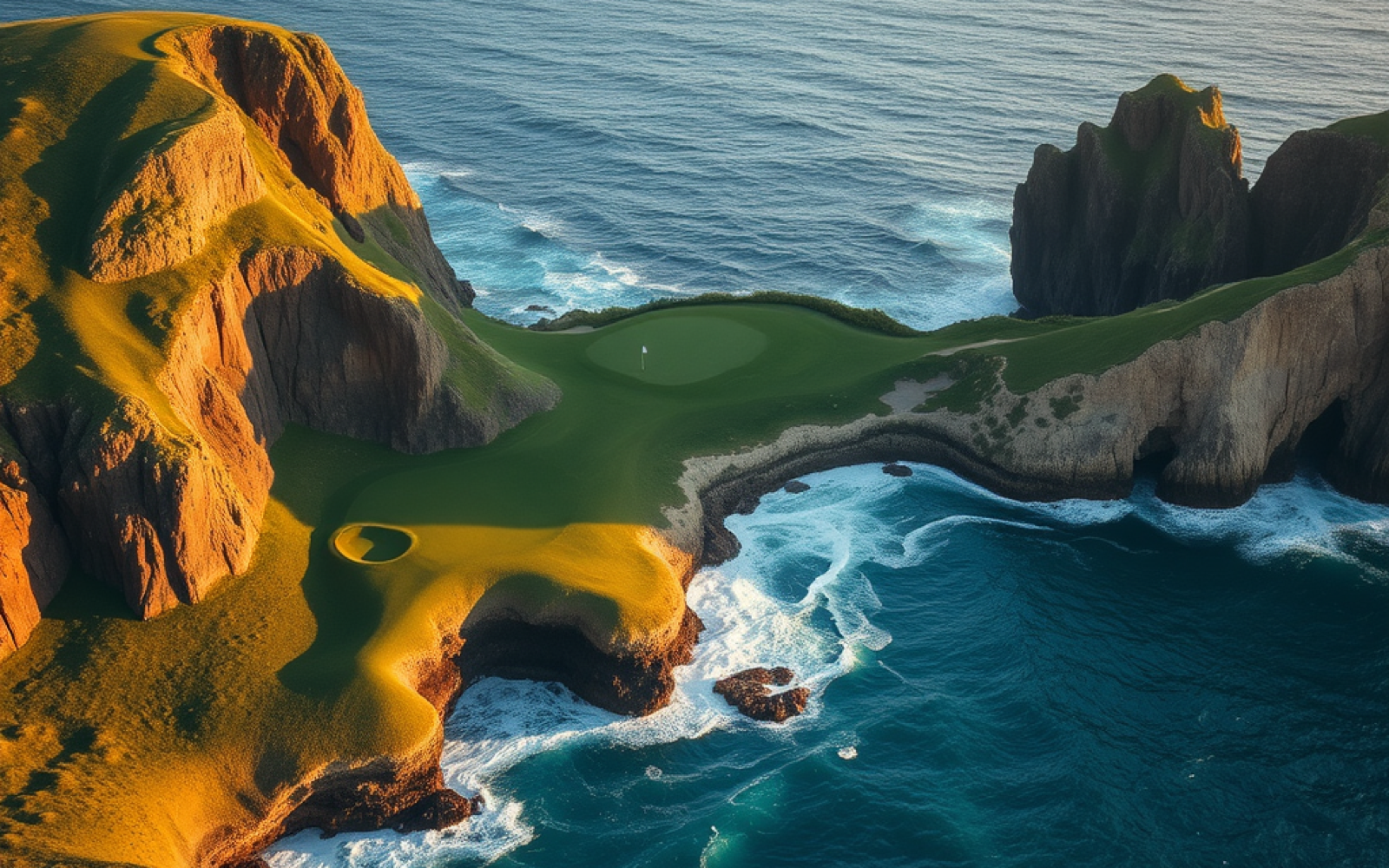



What struck me the first time I walked Augusta National’s hallowed grounds was the sheer scale of everything. The azaleas bloom larger than you’d imagine, the slopes are more dramatic than television can convey, and the greens roll faster than seems physically possible. This is golf’s cathedral, where every April the world’s best players chase the green jacket through corridors of Georgia pine and across putting surfaces that have humbled champions for nine decades.
I believe this is golf architecture at its most transcendent. Augusta National isn’t just a golf course, it’s a living testament to what happens when visionary design meets meticulous stewardship. The property has evolved considerably since opening day in 1933, yet Bobby Jones’ original philosophy remains intact: reward bold, strategic play while punishing indecision. Standing on these fairways, you understand why this course consistently ranks among the world’s elite.
History and Design
The story of Augusta National begins in 1931, when Bobby Jones partnered with legendary architect Alister MacKenzie to transform a former indigo plantation into golf’s most exclusive stage. Jones, having just completed his Grand Slam, wanted to create a course that emphasized strategic interest over penal architecture. MacKenzie, fresh from his masterwork at Cypress Point, brought the design philosophy that wide fairways and boldly contoured greens would separate the great players from the merely good.
The course opened for play in January 1933, though MacKenzie sadly never saw his creation host its first Masters in 1934, having died the previous year. What I find fascinating about Augusta’s history is how it’s continuously evolved under the guidance of some of golf’s greatest minds. Perry Maxwell made significant changes in the 1930s and 1940s, Robert Trent Jones Sr. contributed revisions in the 1940s and 1950s, and more recently, Tom Fazio has overseen major renovations to restore MacKenzie’s original strategic intent while adding length to challenge modern equipment.
The club has lengthened the course from its original 6,700 yards to over 7,500 yards for Masters play. Yet what makes Augusta National architecturally significant isn’t just its championship pedigree, it’s how the design creates infinite strategic options. Jones wanted a course where a player could make a six or a three on any hole, where boldness was rewarded and caution merely kept you alive.
Course Layout and Signature Holes
Augusta National plays as a par 72 measuring approximately 7,555 yards from the championship tees, though exact yardages shift annually depending on hole locations. The routing is pure genius, with the front nine climbing steadily upward before the back nine tumbles downhill through Amen Corner and along Rae’s Creek. What I love about this layout is how it builds tension, with relatively scorable early holes giving way to one of golf’s most dramatic closing stretches.
The par-4 1st hole (Tea Olive) plays uphill at 445 yards, immediately testing your nerve with a narrow chute of pines framing the fairway. The par-5 2nd (Pink Dogwood) stretches to 575 yards, demanding a precise tee shot and rewarding those who challenge the bunkers guarding the green. But it’s the par-4 3rd (Flowering Peach) at just 350 yards where MacKenzie’s brilliance shines, a drivable hole with a green so severely contoured that getting close to certain pins requires thinking three shots ahead.
The par-3 6th (Juniper) plays downhill at 180 yards to a green complex that’s deceptively simple yet brutally difficult to two-putt. Then comes Amen Corner, starting with the par-4 11th (White Dogwood) at 520 yards, where the second shot plays to a narrow green guarded by water on the left. The par-3 12th (Golden Bell) measures just 155 yards but has destroyed more Masters dreams than any hole in golf, with swirling winds and Rae’s Creek creating doubt in even the most confident player’s mind.
The par-5 13th (Azalea) epitomizes risk-reward golf at 510 yards, sweeping left around the creek to a green tucked in the far corner. I’d argue that the strategic decisions required here under Sunday pressure represent course design at its purest. The closing stretch from 15 through 18 has produced countless dramatic moments, with the par-5 15th and par-5 16th offering eagle opportunities that can change tournaments in a single swing.

Get the Edge on Every Tournament
AI-powered predictions, data-driven analysis, and expert picks delivered before every PGA Tour event.
Try Golf Agent ProWhat Makes It World-Class
What separates Augusta National from other elite courses is its ability to simultaneously be player-friendly and championship-caliber. The fairways are generous, there’s minimal rough, and the course encourages aggressive play. Yet those lightning-fast greens with their dramatic slopes create a second layer of challenge that’s invisible to television viewers but omnipresent to players standing over crucial putts.
The conditioning is simply unmatched anywhere in golf. The turf is maintained to a standard that seems almost unnatural, with fairways playing firm and fast, greens rolling at speeds that would terrify most superintendents, and every blade of grass precisely manicured. This level of perfection creates a playing surface where precision matters exponentially more than on typical tour venues.
I believe Augusta’s genius lies in how it tests every aspect of a player’s game without feeling overtly penal. You can recover from wayward drives, but you can’t recover from tentative thinking or poor course management. The strategic choices MacKenzie and Jones built into the routing remain relevant nearly a century later, which is the ultimate measure of great architecture. Modern players hit it farther than Jones could have imagined, yet the course still identifies the week’s best player through strategy rather than brute force.
Playing Experience
The playing experience at Augusta National exists in a category entirely its own. This is among the world’s most exclusive private clubs, where membership is strictly by invitation and the member list reads like a who’s who of business, sports, and entertainment elite. For the fortunate few who’ve played here outside of Masters week, they universally describe it as golf’s ultimate privilege.
What I’ve heard from those lucky enough to walk these fairways is that the course plays differently than you’d imagine from watching on television. The elevation changes are more dramatic, the greens are faster and more severe, and the overall scale is simply grander. The 10th hole doesn’t just go downhill, it plummets. The 18th doesn’t just climb uphill, it rises relentlessly toward the clubhouse like a final examination.
The atmosphere at Augusta National reflects the club’s dedication to tradition and perfection. There are no scoreboards visible from the course during member play, no yardage markers on sprinkler heads, and no GPS devices allowed. You play golf as it was meant to be played, relying on your caddie’s knowledge and your own eyes to judge distance and read the land. This old-school approach creates an immersion that’s increasingly rare in modern golf.
The clubhouse, with its distinctive white facade and sprawling porches, sits majestically above the course. Inside, the walls display artifacts from golf history and Masters moments that have defined the sport. But unless you’re a member or competing in the Masters, experiencing Augusta National remains a distant dream, one that makes alternative opportunities to witness great Southern golf all the more valuable.
Notable Tournaments and Moments
Augusta National exists for one purpose: hosting The Masters, which it has done every April since 1934 (except during World War II). This is the only major championship played at the same venue annually, creating a continuity and tradition unmatched in professional golf. The course has witnessed every significant moment in Masters history, from Gene Sarazen’s “shot heard ‘round the world” double eagle at the 15th in 1935 to Tiger Woods’ dominant 1997 victory by 12 strokes.
The 1986 Masters saw 46-year-old Jack Nicklaus charge home with a final-round 65 to win his sixth green jacket. The back nine that Sunday produced some of golf’s most iconic images, with Nicklaus raising his putter after birdieing 17 while son Jackie carried his bag. I’d argue that no single round has better demonstrated how Augusta National’s design rewards bold, aggressive play when the pressure is highest.
More recent history includes Phil Mickelson’s emotional 2004 victory, his first major championship won with a birdie putt on 18. Tiger Woods’ 2019 comeback triumph, fourteen years after his previous Masters win, produced roars that echoed through the Georgia pines. Jordan Spieth’s collapse in 2016, when he hit two balls into Rae’s Creek at 12, showed how quickly Augusta can devastate even the most talented players.
The course record of 63 has been shot twice, first by Nick Price in 1986 and then matched by Greg Norman in 1996. Yet what makes these moments special isn’t just the scores but where they occurred, on a course that’s witnessed more dramatic golf than perhaps any venue in the sport’s history.
Visitor Information
Augusta National operates as one of golf’s most exclusive private clubs, and public access is essentially non-existent outside of The Masters tournament. There are no guest privileges available, no corporate outings hosted, and membership comes only through invitation from existing members. The club famously admits only about 300 members, making this golf’s most selective sanctuary.
For those hoping to witness this masterpiece firsthand, attending The Masters represents the only realistic option. Tournament badges are distributed through an annual lottery system, with applications typically accepted in the summer preceding the following April’s tournament. The lottery is highly competitive, and securing badges requires both luck and persistence. Once you have tickets, the experience of walking these grounds during tournament week is unlike anything else in sports.
Daily admission prices for The Masters vary depending on the day, with practice round badges generally more attainable than competition round tickets. The tournament experience includes access to the course and grounds but not guaranteed seats in grandstands, which require separate seating badges distributed through the same lottery system. More information about the ticket lottery and tournament details can be found through official channels.
For those who can’t access Augusta National directly, several outstanding courses in Georgia offer excellent golf in similar terrain. The Georgia National Golf Club, located about 30 minutes from Augusta, provides a championship-caliber experience designed by Denis Griffiths. Champions Retreat, just 15 minutes away, features 27 holes designed by Arnold Palmer, Jack Nicklaus, and Gary Player. These alternatives won’t replicate Augusta’s magic, but they showcase the region’s golf heritage.
The Verdict
Augusta National earns its ranking as the world’s 16th-greatest course through a combination of visionary architecture, meticulous conditioning, and historical significance that no other venue can match. This is where Jones and MacKenzie’s strategic philosophy comes alive, where boldness is rewarded and caution merely keeps you competitive. Every serious golfer should dream of walking these fairways, even if that dream remains perpetually deferred by the club’s exclusivity.
Frequently Asked Questions
- Can the public play Augusta National Golf Club?
- No, Augusta National is a strictly private club with no public access. The only way to experience the course is through invitation from a member or by attending The Masters tournament as a spectator.
- How much does it cost to play Augusta National?
- Membership fees are not publicly disclosed, but Augusta National is one of the world's most exclusive clubs. Initiation fees are rumored to be in the tens of thousands of dollars, with annual dues also substantial, though exact figures remain confidential.
- What is the most famous hole at Augusta National?
- The par-3 12th hole, Golden Bell, is arguably the most famous at just 155 yards. This treacherous hole at the heart of Amen Corner has destroyed countless Masters dreams with its swirling winds and Rae's Creek fronting the green.
- When was Augusta National Golf Club founded?
- Augusta National was founded in 1931 by Bobby Jones and Clifford Roberts, with the course designed by Alister MacKenzie. The club officially opened for play in January 1933 and hosted its first Masters tournament in 1934.
- How long is Augusta National Golf Club?
- Augusta National plays at approximately 7,555 yards from the championship tees used during The Masters, though the course has been lengthened significantly from its original 6,700 yards to challenge modern equipment and playing abilities.
Looking for an edge on the PGA Tour? Golf Agent Pro delivers AI-powered insights for every tournament.