


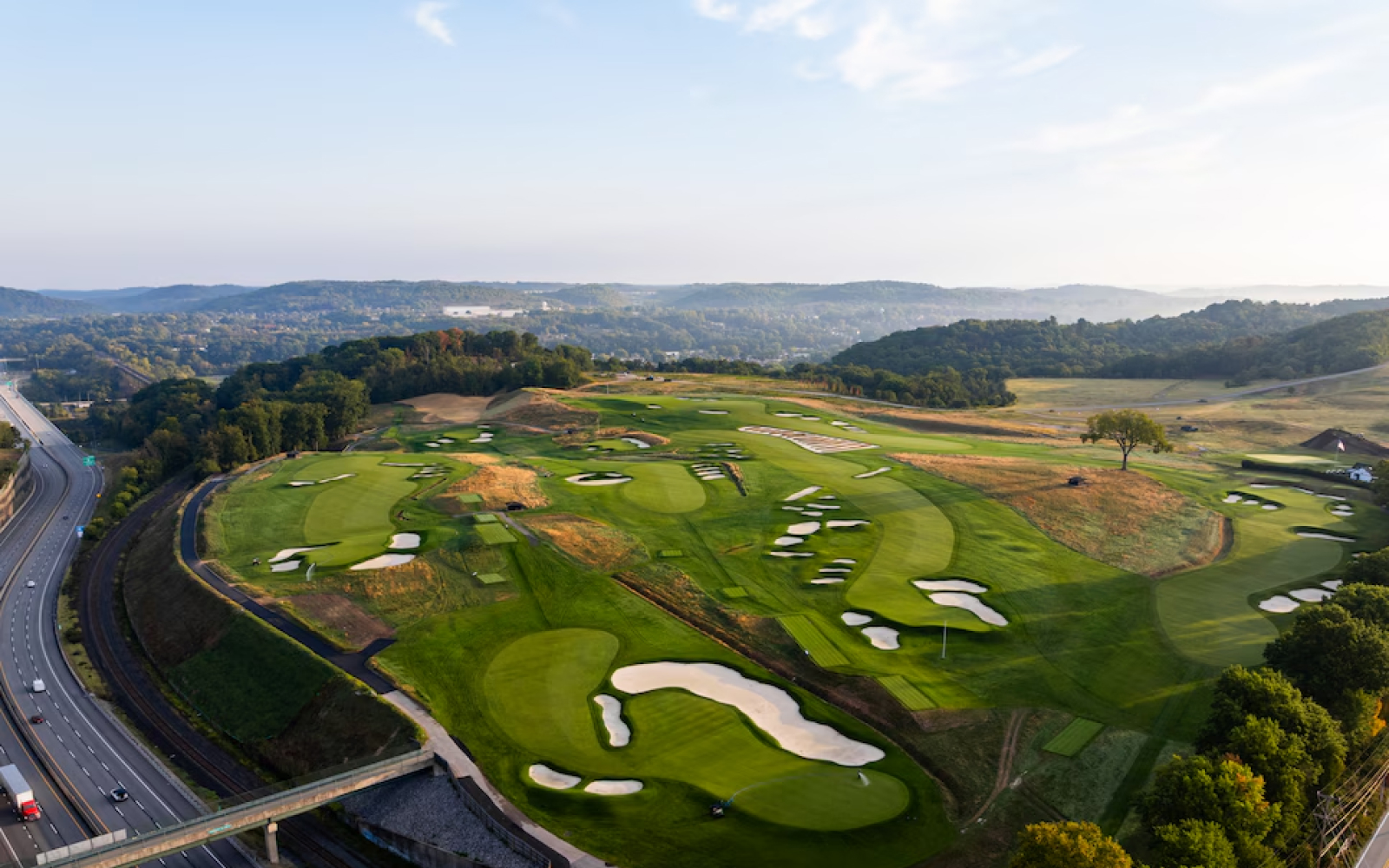
Standing on the first tee at Oakmont Country Club, 15 miles northeast of Pittsburgh, you’re looking at what many consider the most demanding opening hole in championship golf. At 488 yards, it’s a statement of intent from a course that has never apologized for its brutality. What strikes me most about Oakmont isn’t just its difficulty but its unapologetic commitment to testing every aspect of the game. This is a course that was designed to identify champions, and after hosting nine U.S. Opens and five U.S. Amateurs, it has succeeded brilliantly.
The routing plays across gently rolling farmland that Henry Fownes purchased in 1903, but there’s nothing gentle about the challenge. The greens are famous for running at speeds that would make most tour pros nervous, the bunkers are deep enough to swallow golf carts, and the rough is maintained with surgical precision to punish anything offline. I’d argue that Oakmont represents American golf architecture at its most demanding and most honest.
History and Design
Henry Clay Fownes, a Pittsburgh industrialist and passionate golfer, founded Oakmont in 1903 with a singular vision: create the toughest golf course in America. He succeeded. Fownes and his son William designed the original layout, opening for play in 1904, and their philosophy was clear from the start. They believed golf should reward precision and punish mistakes without mercy.
The original design featured more than 350 bunkers, including the infamous Church Pews, a massive hazard between the third and fourth fairways with 12 rows of grass ridges that looked like church pews from above. Over the decades, several architects left their marks on Oakmont, including William Flynn in the 1930s and Emil Loeffler in the 1960s. The most significant recent restoration came from Gil Hanse, whose work beginning in 2020 returned many features to their golden-era glory while preparing the course for the 2025 U.S. Open.
What I love about Oakmont’s history is how it has evolved while maintaining Fownes’ original intent. The course has been lengthened to keep pace with modern equipment, now measuring over 7,200 yards from the championship tees, but the strategic demands remain rooted in precision and course management. The greens were converted from bent grass to a poa annua-bentgrass mix that allows for the terrifying speeds Oakmont is known for, often running at 14 or 15 on the Stimpmeter during major championships.
Course Layout and Signature Holes
Oakmont plays to a par 71 with four par 5s, 11 par 4s, and three par 3s. The total yardage stretches to 7,255 yards for major championships, though members play it somewhat shorter. What makes the routing special is how each hole presents a distinct challenge while building toward a crescendo finish.
The opener demands a long, precise tee shot followed by an approach to an elevated green that slopes severely from back to front. In the 2016 U.S. Open, it played as the hardest hole on the course with a stroke average of 4.45. The second hole offers strategic variety, a short par 4 of just 346 yards where players must decide whether to challenge the green with driver or lay back with an iron.
The third hole is where Oakmont truly announces itself. At 462 yards, this par 4 features the Church Pews bunker complex on the left, a series of deep bunkers on the right, and an elevated green that requires a high, soft approach shot. Tiger Woods made his only double bogey here in the final round of the 2007 U.S. Open, a testament to its difficulty.
The par 3 eighth hole plays 296 yards and is one of the longest one-shotters in championship golf. The green is massive but slopes dramatically, making distance control as important as direction. I believe this hole exemplifies Oakmont’s philosophy: length alone won’t save you if your ball ends up on the wrong tier.
The back nine builds intensity toward the finish. The 15th, a 507-yard par 4, is the longest two-shot hole in major championship golf and often plays downwind, tempting players to go for the green in regulation despite the risk. The 17th, a 313-yard par 4, offers risk-reward drama with a narrow green protected by bunkers that demand perfect execution.
This flyover tour with former head professional Bob Ford provides a comprehensive look at every hole at Oakmont, giving you a sense of the strategic challenges and the dramatic green complexes that define this legendary layout.
What Makes It World-Class
Oakmont earns its ranking as the world’s eighth-best course through a combination of architectural excellence, historical significance, and sheer difficulty. Apart from Augusta National, home to the Masters, no course in America has hosted more major championships. Nine U.S. Opens have been contested here, along with five U.S. Amateurs, two PGA Championships, and numerous other significant events.
The greens are what separate Oakmont from every other course. Running at speeds that professional golfers describe as the fastest they’ve ever played, these putting surfaces demand absolute precision in approach shots and nerves of steel on downhill putts. The famous story of W.C. Fownes Jr. dropping balls on the second green and demanding to know why they didn’t roll off the front tells you everything about Oakmont’s philosophy.
The bunkering is equally distinctive. While Hanse’s restoration reduced the total number from 210 to around 180, each hazard serves a strategic purpose. The bunkers feature steep faces and deep bases that can require multiple shots to escape. What I admire most is how these hazards force players to make decisions on every shot, whether to challenge them for a better angle or play safe to the generous fairways.
The course also adapts brilliantly for championship play. The rough can be grown to U.S. Open heights that make finding the fairway essential, while the firm greens reject anything but perfectly struck approaches. Yet for members playing daily, Oakmont remains challenging but fair from forward tees with more manageable rough heights.

Get the Edge on Every Tournament
AI-powered predictions, data-driven analysis, and expert picks delivered before every PGA Tour event.
Try Golf Agent ProPlaying Experience
Oakmont is a private club with approximately 500 members, making access extremely limited for outside play. The only realistic way to experience the course is through a member invitation, though the club occasionally hosts corporate outings and charity events. The exclusivity adds to the mystique, but it also means most golfers will only experience Oakmont through television coverage or dreams.
For those fortunate enough to play here, the experience is unforgettable. The course condition is impeccable year-round, maintained by a grounds crew that takes pride in presenting championship-caliber surfaces daily. Walking Oakmont provides a better sense of the subtle elevation changes and strategic angles that don’t always translate on television.
The atmosphere around the clubhouse area, with its red brick colonial architecture overlooking the 18th green and first tee, exudes old-school golf tradition. The practice facilities are world-class, as you’d expect from a venue that regularly hosts major championships. What strikes me most during rounds here is the strategic variety: every hole demands thought and precision, not just power.
The nearby Pittsburgh area offers several outstanding public alternatives for those unable to access Oakmont. Laurel Valley Golf Club, about 40 miles east, has hosted major championships and offers a similarly rigorous test when member play allows guest access. For guaranteed public access, Quicksilver Golf Club designed by Arnold Palmer provides an excellent daily-fee experience about 30 miles away.
Notable Tournaments and Moments
Oakmont’s tournament history reads like a who’s who of golf legends. The first U.S. Open held here in 1927 was won by Tommy Armour in a playoff over Harry Cooper. In 1953, Ben Hogan captured his fourth U.S. Open title at Oakmont, cementing the course’s reputation as a champions’ venue.
The 1962 U.S. Open produced one of golf’s most famous playoffs when Jack Nicklaus, still an amateur earlier that year, defeated Arnold Palmer in an 18-hole playoff to win his first major. Playing in Palmer’s backyard made the victory even sweeter. Johnny Miller’s final-round 63 at Oakmont in the 1973 U.S. Open remains one of the greatest rounds in major championship history, a display of iron play that seemed impossible on greens running at championship speeds.
More recently, Angel Cabrera’s victory in the 2007 U.S. Open showcased how Oakmont can identify true ball-strikers. The Argentine’s power and accuracy proved perfectly suited to the course’s demands. In 2016, Dustin Johnson finally broke through for his first major championship at Oakmont, overcoming a controversial penalty ruling on the fifth green of the final round to win by three shots.
What I find remarkable about Oakmont’s championship history is the variety of winners. Long hitters like Johnson and Cabrera have prevailed, but so have precision players like Hogan and Miller. The course identifies champions rather than favoring a particular style, which speaks to the quality and completeness of the test.
Visitor Information
As a private club, Oakmont does not offer public tee times or daily-fee play. Green fees for guests playing with members are not publicly disclosed, though the club’s prestige suggests significant cost. The course is accessible only through member invitation, corporate outings arranged through the club, or occasional charity events.
The best time to experience the course, weather-wise, runs from May through October, when conditions in western Pennsylvania are most favorable. The course plays firm and fast in summer, especially during championship conditions. Fall brings spectacular foliage that frames the parkland setting beautifully.
For those interested in experiencing championship golf in the Pittsburgh area without member access, Nemacolin Woodlands Resort’s Mystic Rock course designed by Pete Dye offers a dramatic daily-fee option about 70 miles southeast. Closer to Pittsburgh, Totteridge Golf Course provides an excellent semi-private experience with reasonable green fees and a layout that tests all aspects of your game, similar to how understanding course history matters in evaluating golf challenges.
If you’re planning to attend the 2025 U.S. Open at Oakmont, ticket information and tournament details are available on the official website. The USGA typically releases ticket packages 12 to 18 months before the championship, with options ranging from daily grounds passes to premium hospitality experiences.
The Verdict
Oakmont Country Club stands as the ultimate test of championship golf in America, a course that separates pretenders from champions through sheer difficulty and strategic complexity. Every golfer serious about the game should have this course on their bucket list, even if access means watching a U.S. Open rather than playing a round. The architecture, history, and uncompromising challenge make Oakmont essential viewing for anyone who wants to understand what great golf course design looks like at its most demanding.
Frequently Asked Questions
- Can the public play Oakmont Country Club?
- No, Oakmont is a private club accessible only through member invitation. The only way for non-members to experience the course is through corporate outings arranged with the club, charity events, or by attending tournaments like the U.S. Open.
- What is the hardest hole at Oakmont Country Club?
- The first hole consistently ranks as Oakmont's toughest, playing as a 488-yard par 4 that demands precision off the tee and a mid-iron approach to a severely sloped green. During the 2016 U.S. Open, it played to a stroke average of 4.45.
- How fast are the greens at Oakmont?
- Oakmont's greens regularly run at 13-14 on the Stimpmeter for daily play and can reach 14-15 during major championships, making them among the fastest in the world. The severe slopes combined with these speeds create some of golf's most challenging putting surfaces.
- When is the next U.S. Open at Oakmont?
- The 2025 U.S. Open will be contested at Oakmont Country Club from June 12-15, marking the course's tenth time hosting the championship. This will showcase Gil Hanse's restoration work completed in recent years.
- What are the best public golf courses near Oakmont?
- For championship-caliber public golf near Pittsburgh, consider Nemacolin Woodlands Resort's Mystic Rock (70 miles southeast), Quicksilver Golf Club (30 miles north), or Totteridge Golf Course within the Pittsburgh metro area, all offering excellent tests without requiring member access.
Looking for an edge on the PGA Tour? Golf Agent Pro delivers AI-powered insights for every tournament.