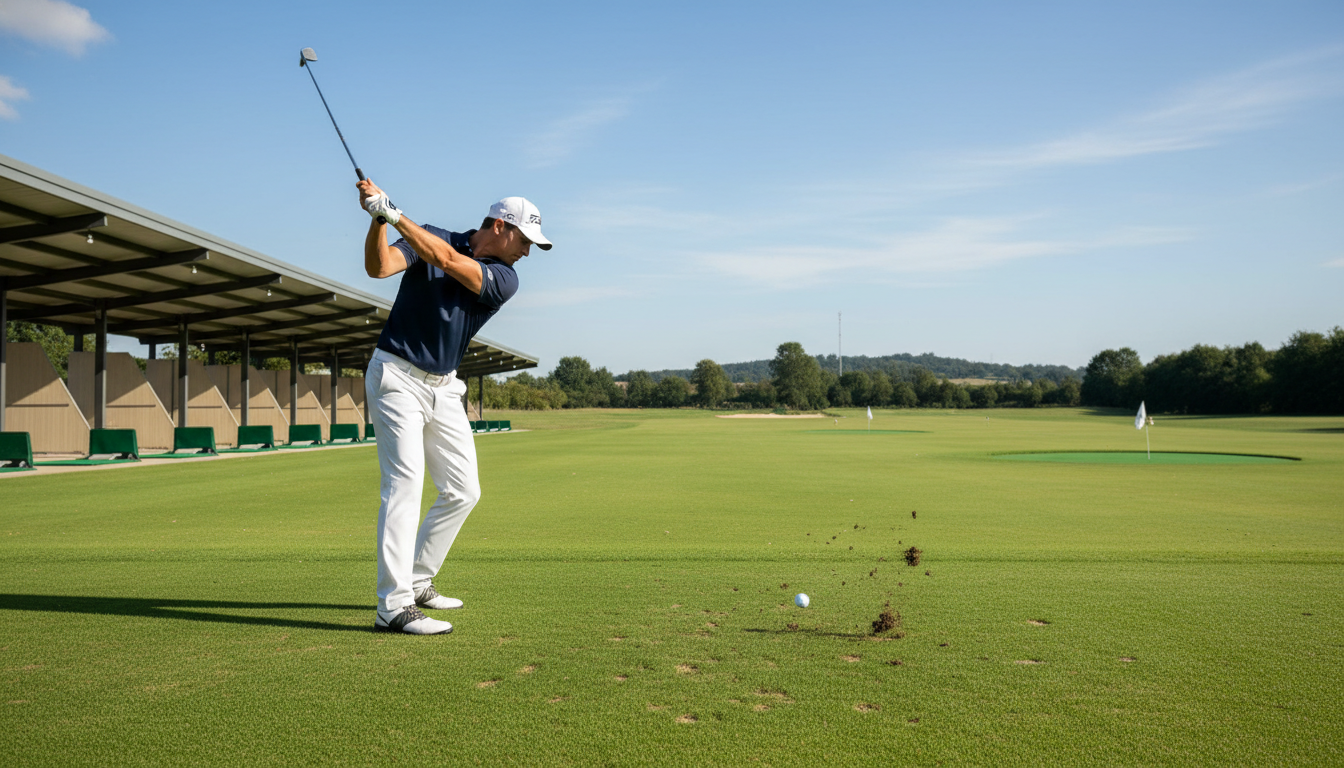



I’ve watched countless golfers pound through bucket after bucket at the range, and honestly, most of them are just rehearsing their mistakes. They think more swings equal more improvement, but that’s not how skill development works in golf or any other complex activity.
The truth is that effective golf practice isn’t about volume. It’s about intention, structure, and quality repetitions that directly address your actual weaknesses. I’ve seen players drop 5-7 strokes in a season not by practicing more, but by practicing smarter with a deliberate plan.
Why Most Golf Practice Fails
Walk into any driving range on a Saturday morning and you’ll see the same pattern. Golfers grab a bucket, start with a wedge to warm up, then work through the bag hitting their favorite clubs to no particular target. They finish with the driver because it’s fun, pack up, and call it practice.
This approach fails because it lacks the three critical elements of skill development: specific goals, honest feedback, and progressive challenge. You’re essentially on autopilot, reinforcing whatever swing patterns you already have, good or bad.
I think the biggest mistake is confusing “playing golf” with “practicing golf.” When you just hit shots without a clear objective or consequence, you’re not building the decision-making and pressure management skills that separate good rounds from great ones.
Start With Honest Game Assessment
Before you can practice effectively, you need to know what actually costs you strokes on the course. I recommend tracking these four categories for at least three rounds: driving (fairways hit and penalties), approach shots (greens in regulation), short game (up-and-down percentage), and putting (putts per round and three-putt frequency).
Most golfers are shocked when they see the data. You might feel like your driver is the problem, but the numbers show you’re losing four strokes per round around the greens. That’s the kind of clarity that transforms practice from guesswork into targeted improvement.
This video from The Golfer’s Journal breaks down exactly how to assess your game and identify real weaknesses versus perceived ones. The key takeaway is that you can’t fix what you don’t measure, and most golfers practice their strengths while avoiding their weaknesses.
The 70-20-10 Practice Framework
I recommend dividing your practice time using the 70-20-10 rule. Spend 70% on random, game-like practice where you simulate real course situations. Use 20% for targeted block practice on specific mechanical issues or new skills. Reserve 10% for pure fundamentals like grip, setup, and alignment checks.
This distribution mirrors how skills transfer to actual play. The random practice (hitting different clubs to different targets with consequences) builds adaptability and decision-making. The block practice improves specific movements. The fundamentals work prevents bad habits from creeping in over time.
What I’ve found is that most golfers flip this ratio. They spend 80% on block practice (hitting the same club repeatedly), 15% on fundamentals, and maybe 5% on anything resembling actual golf. That’s why their range game doesn’t translate to the course.
Building a 30-Minute Quality Session
When time is limited, structure becomes everything. I start every session with 5 minutes of purposeful warm-up, focusing on tempo and rhythm with short irons, similar to the approach I outline in my guide on building a pre-shot routine that lowers your scores. Then I spend 20 minutes on targeted skill work based on my current weakness, using specific drills with measurable outcomes.
The final 5 minutes are always dedicated to simulating pressure. I’ll play three imaginary holes, choosing different clubs and visualizing specific shots I’ve struggled with recently. If I don’t execute, I repeat that shot until I do it correctly twice in a row.
This practice plan from The Scratch Plan demonstrates exactly how to structure efficient sessions whether you have 30 minutes or three hours. The main lesson is that following a template eliminates decision fatigue and keeps you focused on improvement, not entertainment.
Random Practice Beats Block Practice
Here’s what changed my own game: I stopped hitting the same club repeatedly and started treating each shot like it mattered. Instead of 10 seven-irons in a row, I hit one seven-iron to a specific target, then switched to a different club and target for the next shot.
This random practice approach forces your brain to problem-solve every time, which is exactly what you do on the course. Research in motor learning consistently shows that random practice produces better retention and transfer than blocked repetitions, even though it feels harder and less satisfying in the moment.
I recommend picking 10 different targets at various distances and hitting one ball to each target with the appropriate club. Track your success rate. This gives you immediate feedback and creates a scoring system that makes practice competitive with yourself.

Get the Edge on Every Tournament
AI-powered predictions, data-driven analysis, and expert picks delivered before every PGA Tour event.
Try Golf Agent ProCreate Pressure in Practice
The gap between range performance and course performance exists because most practice has zero consequences. I’ve learned to build pressure into every session by creating games with rules and penalties that matter to me.
One of my favorites is the “nine ball challenge.” Pick nine different shots that represent a typical round (driver, long iron, mid-iron, short iron, three wedges, and two putts). You have to execute all nine successfully to complete the drill. If you miss, start over. It sounds simple, but the pressure of getting to shot eight and knowing you have to start over if you miss creates real tension.
Another effective method is practicing with a playing partner and making small wagers or challenges on specific outcomes. The social pressure and friendly competition immediately elevate focus and mirror competitive situations better than solo practice ever can.
Short Game Practice That Transfers
I spent years hitting chip shots to random spots on the practice green, wondering why I still chunked them under pressure. The problem was that I wasn’t practicing with consequence or tracking results against a standard.
Now I use structured games with clear success thresholds. For chipping, I’ll pick six different lies and situations around the green and require myself to get up and down on four of six before moving on, applying the principles I cover in my article on chipping vs pitching strategies around the green. For putting, I use the circle drill: five balls at three feet, five at six feet, and five at nine feet, aiming to make 12 of 15.
What I’ve found is that giving yourself specific targets and consequences forces you to develop a reliable routine and commit to each shot. That’s the skill you need on the course, not the ability to hit 50 chips in a row from the same perfect lie.
The Role of Video and Feedback
I used to avoid filming my swing because I didn’t want to see how different it looked from what it felt like. But honest feedback is essential for improvement, and video doesn’t lie.
I recommend filming your swing from down-the-line and face-on angles at least once per month. You don’t need expensive equipment; your phone works perfectly. Compare your positions to the checkpoint you’re working on with your instructor or from quality instruction sources.
The key is using video as feedback, not as a replacement for feel. I’ll record a few swings at the start of a session to confirm my setup and positions, then put the camera away and practice the feel. Video is a tool for calibration, not constant monitoring.
Track Progress With Measurable Metrics
You can’t manage what you don’t measure, and improvement requires quantifiable data. I keep a simple practice journal where I record the date, what I worked on, and specific results from any drills or challenges I attempted.
For example, instead of writing “practiced putting,” I’ll note “circle drill: made 11 of 15 (73%), best streak was 6 in a row.” This creates a baseline I can try to beat in the next session and provides objective evidence of improvement over time.
I’ve found that tracking also increases accountability and motivation. When you see the numbers improving over weeks and months, it validates the process and encourages you to keep showing up with purpose, just as tracking statistics helps with course management strategy.
When to Work With an Instructor
Even the most dedicated practice won’t help if you’re working on the wrong things or building compensations into your swing. I believe every golfer benefits from periodic check-ins with a qualified instructor who can provide expert eyes and structure to their improvement plan.
I recommend seeing an instructor at least quarterly if you’re serious about improvement. They can identify swing issues you can’t feel or see, provide drills tailored to your specific pattern, and adjust your practice plan as you progress.
The instructor’s role is to give you a clear roadmap and the tools to practice independently. If you’re seeing your teacher every week but not practicing effectively between lessons, you’re just renting improvement instead of building it.
Frequently Asked Questions
- How long should an effective golf practice session last?
- Quality matters more than duration. A focused 30-minute session with specific goals and structured drills produces better results than two hours of mindless ball-beating. I recommend 30-60 minutes for most golfers.
- What percentage of practice time should I spend on putting versus full swing?
- Base this on where you lose strokes. Most golfers should spend 40-50% of practice time on short game and putting since that's where scoring happens. Track your stats to find your actual weaknesses, not your perceived ones.
- Is it better to practice at a driving range or on a golf course?
- Both serve different purposes. Range practice builds mechanics and allows repetition, while on-course practice develops decision-making and course management. I recommend 70% range work for skill development and 30% on-course practice for score improvement.
- How do I know if my practice routine is actually working?
- Track measurable outcomes like fairways hit percentage, greens in regulation, and putts per round over 10+ rounds. If these numbers improve over 2-3 months, your practice is effective. If not, reassess your priorities and methods.
- Should I practice my weaknesses or focus on my strengths?
- Always prioritize weaknesses that cost you the most strokes. A weak driver that loses one ball per round is a bigger priority than improving your already-solid wedge game. Fix what's broken before polishing what works.
Looking for an edge on the PGA Tour? Golf Agent Pro delivers AI-powered insights for every tournament.