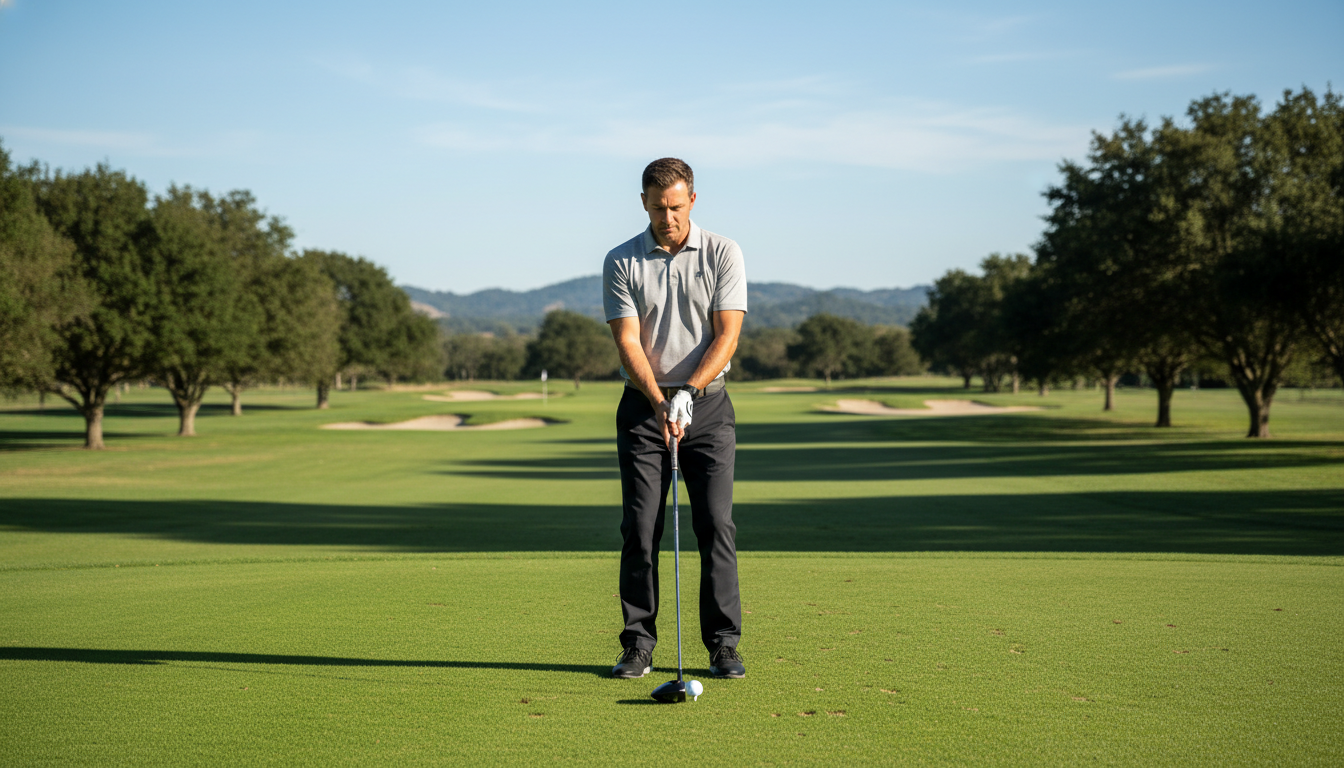



I’ve spent years chasing more clubhead speed, thinking that was the secret to better golf. But here’s what I’ve learned: tempo matters way more than raw speed. I’ve seen countless golfers with 115+ mph swings who can’t break 80, while smooth swingers with 95 mph tempo consistently shoot in the 70s.
The difference isn’t how fast you swing. It’s how consistently you control the rhythm of your motion from start to finish.
What Golf Swing Tempo Actually Means
Golf swing tempo is the ratio between your backswing time and your downswing time. Research by John Novosel revealed that most tour players maintain a 3:1 ratio, meaning their backswing takes three times longer than their downswing. This isn’t about swinging slowly or quickly in absolute terms. It’s about maintaining a consistent relationship between the two halves of your swing.
I think the best way to understand tempo is to compare it to music. A song can be fast or slow, but if the rhythm stays consistent, it sounds smooth. Your golf swing works the same way.
Why Tempo Beats Pure Speed Every Time
Speed without control is just violence. I’ve found that golfers who focus exclusively on generating clubhead speed develop inconsistent strike patterns, erratic ball flights, and frustrating rounds. When you prioritize tempo, speed actually increases naturally because you’re creating efficient sequencing.
Think about Ernie Els or Fred Couples. Neither swings particularly hard, but both generate tremendous power through perfect tempo. Their smooth, rhythmic swings allow their bodies to sequence properly, transferring energy efficiently from the ground up through the club.
Here’s what proper tempo gives you that pure speed doesn’t: consistent contact, predictable ball flight, better balance, and repeatable mechanics under pressure.
This drill from Meandmygolf demonstrates how maintaining smooth tempo creates effortless power. The key takeaway is that when you stop forcing speed, your natural athletic motion produces better results.
The Science Behind Tempo and Consistency
I recommend tracking your tempo ratio because data doesn’t lie. When I started measuring my own swing with launch monitors, I discovered my tempo varied wildly from 2.5:1 to 4:1 depending on the situation. My best shots all clustered around 3:1, just like the tour pros.
The reason consistency matters so much is that golf is a game of patterns. When your tempo stays constant, your body learns one motion instead of several. Your brain can predict the timing of impact, your muscles can fire in sequence, and your club can square up predictably.
Research shows that tempo consistency correlates more strongly with handicap improvement than swing speed increases. In other words, a golfer who maintains 3:1 tempo with 90 mph speed will outperform someone swinging 100 mph with erratic tempo ratios.
Three Essential Tempo Drills That Actually Work
The right-left drill is my go-to warmup exercise. Hold your driver and make continuous swinging motions without stopping, going right to left three times. The club must stay in constant motion. This drill forces you to feel rhythm rather than positions. I do this before every range session and before my first tee shot.
The pause-and-go drill helps you identify where you’re rushing. Take your normal backswing, pause for one full second at the top, then complete your downswing. If you can’t maintain balance during the pause, your backswing is too quick or your positions are off. This drill taught me that I was racing to the top and losing my foundation.
The step drill syncs your body rotation with your arm swing. Start with your feet together, take the club back while stepping with your lead foot, then swing through. This creates natural rhythm because your body movement dictates your tempo. I use this when I feel disconnected between my arms and body.
Padraig Harrington breaks down how rhythm creates power in this video. Notice how he emphasizes smooth transitions over forcing speed in any single part of the swing.
How to Practice Tempo on the Range
I think most golfers waste their range time by just hitting balls without purpose. When working on tempo, I recommend using specific tools and protocols. The Orange Whip training aid is fantastic because its weighted design naturally promotes smooth tempo. If you swing it jerky or quick, it fights you. Swing it smooth, and it flows.

Get the Edge on Every Tournament
AI-powered predictions, data-driven analysis, and expert picks delivered before every PGA Tour event.
Try Golf Agent ProTour Tempo beats are another tool I’ve used extensively. These are audio tones that beep in a 3:1 ratio, helping you internalize the proper timing. You can download apps that provide these beats and practice swinging to them. At first it feels awkward, but after 20-30 swings, your body starts to sync with the rhythm naturally.
Here’s my practice protocol: Start every session with 10 continuous motion swings (the right-left drill). Then hit 10 balls while counting “one-two-three” on the backswing and “one” on the downswing. Focus entirely on matching that rhythm, not on where the ball goes. You’ll be shocked how purely you strike the ball when tempo is your only thought.
Common Tempo Mistakes and How to Fix Them
The biggest mistake I see is the quick transition. Golfers rush from backswing to downswing without any pause or flow. This destroys sequencing and creates an over-the-top move. The fix is simple: feel like your backswing never stops. It should flow smoothly into the downswing without any hitches or jerks.
Another mistake is the slow, methodical backswing followed by a death grip acceleration. This creates tension and poor timing. Remember, fast and smooth beats slow and violent every time. Your backswing can have good pace as long as it maintains rhythm with your downswing.
Tension is tempo’s enemy. If you’re gripping the club like you’re choking a snake, you can’t have good tempo. I recommend holding the club with about 4 out of 10 pressure. Loose enough to feel the clubhead, firm enough to control it.
Matching Your Tempo to Your Personality
Not everyone should swing with the same tempo. Nick Price had a famously quick tempo (2.5:1 ratio), while Ernie Els was ultra-smooth (3.5:1). The key is finding YOUR natural tempo and then maintaining it consistently.
I’ve found that my best tempo is slightly quicker than tour average, around 2.8:1. That matches my personality and athletic background. When I try to swing like Freddie Couples, I lose rhythm because it’s not authentic to me. Experiment with different tempos and track which one produces your best contact and tightest shot patterns.
Your tempo might also vary by club. Many golfers naturally have a slightly quicker tempo with wedges than with driver. That’s fine as long as you’re consistent within each club category.
Using Technology to Lock in Your Tempo
Modern launch monitors and swing analyzers can measure your tempo ratio on every swing. I think this feedback is invaluable because feel isn’t always real. You might think you’re swinging smoothly while actually rushing the transition.
Apps like HackMotion provide real-time tempo feedback through wrist sensors. After each swing, you see whether you fell within your target ratio. Over time, this trains your body to repeat the same tempo automatically. It’s like having a coach who never gets tired of telling you the same thing.
Video analysis helps too. Record your swing from down-the-line and count frames. Tour players typically take 21-24 frames from takeaway to top, then 7-8 frames from top to impact. If you’re way off those numbers, you’ve identified where your tempo breaks down.
Frequently Asked Questions
- What is the ideal golf swing tempo ratio?
- Most tour professionals maintain a 3:1 ratio (backswing to downswing), but your ideal tempo depends on your natural athletic rhythm. Some players like Nick Price succeeded with 2.5:1, while others like Ernie Els used 3.5:1. Consistency matters more than matching a specific number.
- How can I improve my golf swing tempo quickly?
- Start with the right-left continuous motion drill daily. Make three smooth, unbroken swings without stopping, focusing purely on rhythm. Then use the pause-and-go drill to identify where you're rushing. Most golfers see improvement within 2-3 practice sessions.
- Does swing tempo affect distance?
- Yes, but not how you'd expect. Proper tempo actually increases distance by improving strike quality and sequencing efficiency. A smooth 95 mph swing with good tempo produces more ball speed than a jerky 105 mph swing with poor contact.
- Should my tempo be the same with every club?
- Your tempo ratio should remain consistent across all clubs, though the absolute speed may vary slightly. Most golfers naturally swing wedges a bit quicker than driver, but maintaining your 3:1 (or whatever your ratio is) across the bag creates consistency.
- How do I stop rushing my downswing?
- Focus on making your backswing and downswing feel like one continuous motion rather than two separate movements. Use the counting method: 'one-two-three' on the backswing, 'one' on the downswing. This forces you to give the backswing proper time.
Looking for an edge on the PGA Tour? Golf Agent Pro delivers AI-powered insights for every tournament. If you’re ready to apply these tempo principles and learn how to break 90 in golf, our data-driven guide shows you exactly where to focus your practice time for maximum improvement.