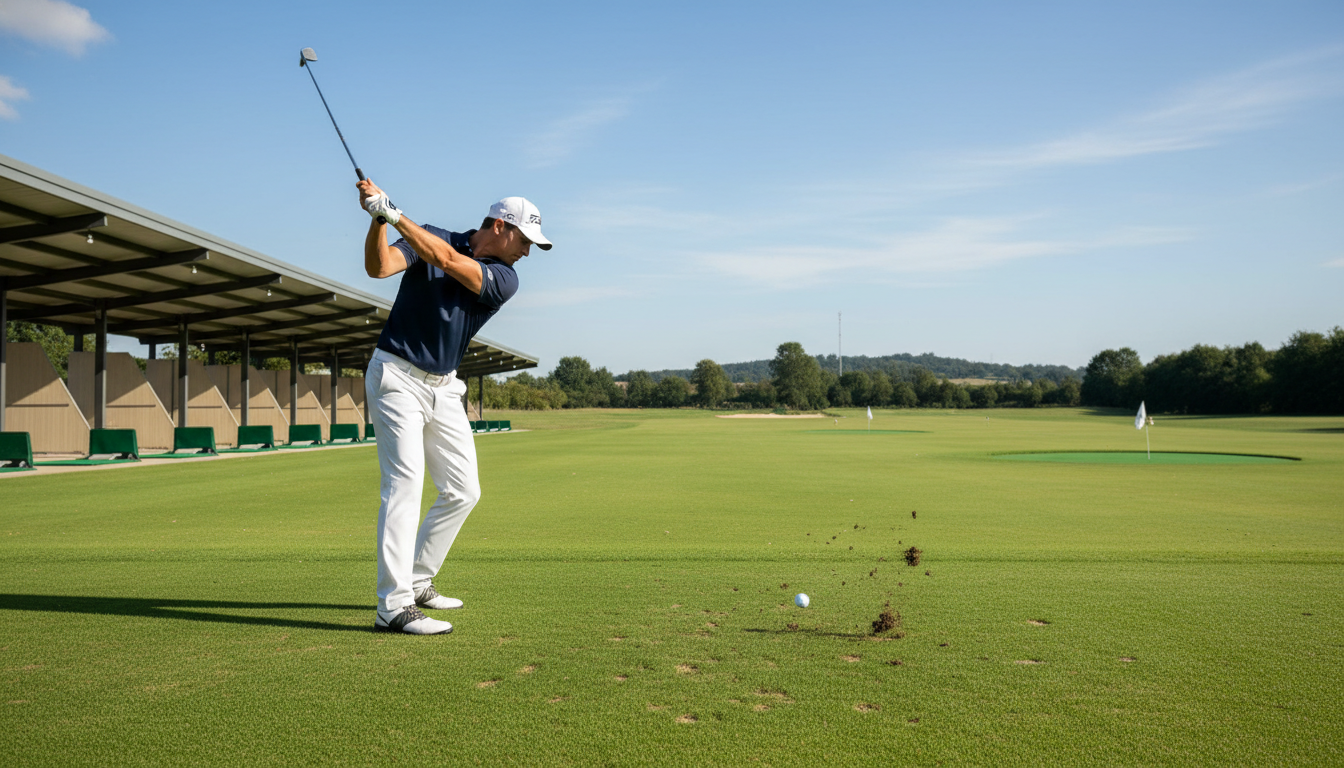



The slice is golf’s most common swing fault, affecting roughly 80% of amateur players. If you’re watching your ball start left then curve dramatically right (for right-handed golfers), you’re losing 20-40 yards of distance and missing fairways. The good news? Most slices stem from two fixable issues: grip position and swing path.
I’m going to walk you through a targeted 15-minute practice session that addresses both root causes. This isn’t about band-aid fixes or swing thoughts that fall apart under pressure. We’re building repeatable mechanics that hold up on the course.
Understanding Why You Slice
Your ball slices because the clubface is open relative to your swing path at impact. For most golfers, this happens in combination: you’re swinging out-to-in (across the ball) while the face aims right of that path. The result is sidespin that sends your ball curving right.
Data from launch monitors shows that a typical slicer’s clubface might be 5 degrees open while their path is 3 degrees left. That 8-degree gap creates the banana ball you’re trying to eliminate. Fix either variable significantly, and you’ll see immediate improvement.
The Grip Fix: Your First 5 Minutes
Your grip controls approximately 80% of your clubface position at impact. A weak grip (where you see one or fewer knuckles on your left hand at address) makes it nearly impossible to square the face through impact. Your hands naturally want to return to neutral, which leaves the face wide open.
Here’s the adjustment: rotate both hands clockwise on the grip until you see 2.5 to 3 knuckles on your left hand. Your right hand’s lifeline should fit snugly over your left thumb. The V formed by your right thumb and forefinger should point toward your right shoulder.
This video demonstrates the proper grip technique and why it matters for eliminating your slice:
The key takeaway here is that your new grip will feel uncomfortably strong at first. That’s normal and necessary. Resist the urge to weaken it back to what feels comfortable because comfortable is what’s been producing your slice.
The Path Drill: Minutes 6-15
Now we address the second culprit: your over-the-top swing path. Most slicers swing from outside to inside because they’re trying to steer the ball or they start the downswing with their shoulders instead of their lower body. This drill fixes both issues in one simple setup.
Place an alignment stick or broken club shaft in the ground about 18 inches outside your ball, angled at roughly 45 degrees toward your target line. Position it so your clubhead would strike it if you swing over the top. Your goal is to swing the club inside that barrier on your downswing.
Here’s how to execute this drill properly:
The magic of this drill is the instant feedback. You’ll hear or feel contact with the stick if you come over the top. Start with slow-motion swings, gradually building speed as the inside path becomes automatic.
The Combined Practice Sequence
Spend 3 minutes making slow practice swings with your new grip and the alignment stick in place. Focus on starting your downswing by bumping your hips toward the target, which naturally drops the club into an inside path. Your arms should feel like they’re swinging more out to right field.
Next, hit 5-7 balls at 50% speed. You’re not trying to crush these. You’re grooving the feel of an inside-out path with a squared clubface. Many golfers see the ball start right and draw back toward the target on these initial swings. That’s perfect and shows you’re overcorrecting, which is exactly what we want during the learning phase.

Get the Edge on Every Tournament
AI-powered predictions, data-driven analysis, and expert picks delivered before every PGA Tour event.
Try Golf Agent ProProgressing to Full Speed
Once you’re consistently hitting 50% speed shots without contacting the stick, remove it and increase to 75% speed. The ball flight you’re looking for is either straight or a gentle draw (curving slightly left). If you see the slice creeping back, it’s almost always because your grip has weakened or you’ve reverted to an outside path.
Hit 10-12 balls at this speed, checking your grip between every shot. Take a slow-motion practice swing before each shot to reinforce the inside path feeling. This is where most golfers want to rush, but maintaining deliberate practice is what makes the change stick.
The Reality Check: What to Expect
In your first session, you should see a dramatic reduction in slice spin. The ball might not go perfectly straight, but the violent curve should be gone. Some golfers overcorrect and hit snap hooks initially because they’ve combined a strong grip with an aggressive inside path. That’s actually encouraging because it means both fixes are working.
Your distance will likely increase by 10-20 yards immediately because you’re no longer bleeding energy into sidespin, similar to the gains you might see when choosing the right shaft weight and flex. The ball will also roll more after landing since draws and straight shots have lower spin rates than slices. Don’t be surprised if your 7-iron suddenly carries an extra club length.
Cementing the Change
The drill with the alignment stick should be part of your warmup routine for the next 5-10 range sessions. Muscle memory takes roughly 3-4 weeks of consistent practice to solidify. During this period, your new grip will start feeling natural, and the inside path will become automatic.
On the course, use a simple swing thought: “knuckles and inside.” Before each shot, glance at your left hand to confirm you see 2.5-3 knuckles, then make one practice swing focusing on the inside path. This two-step mental checklist prevents reverting to old patterns under pressure.
Common Mistakes to Avoid
The biggest error is weakening your grip back to comfortable after a few good shots. Your brain will try to convince you that you’ve fixed it and can return to your old grip. Don’t fall for this. The strong grip needs to stay for at least a month before you consider any adjustments.
Another mistake is swinging too hard too soon. Speed amplifies swing flaws, which is why learning how to increase your golf swing speed properly matters once you’ve fixed your path. If you’re hitting balls well at 75% and start spraying them at 100%, drop back down. Gradually build speed over multiple sessions as the new pattern becomes ingrained.
Taking It to the Course
Your first round with these changes will feel different. You’ll need to aim slightly left of where you used to aim because you’re no longer accounting for a big slice. Start by aiming at the left edge of fairways and greens until you calibrate your new ball flight.
Expect some inconsistency in your first 2-3 rounds. This is normal and part of the learning curve. Trust the process and resist abandoning the changes after a few bad shots. The improvements become permanent around round four or five for most golfers.
The combination of a proper grip and inside swing path addresses the root mechanical causes of your slice. This isn’t a quick fix that falls apart under pressure, it’s a fundamental rebuild that creates a repeatable, powerful swing. Put in these 15-minute sessions consistently, and you’ll join the small percentage of golfers who’ve permanently eliminated their slice.
Looking for an edge on the PGA Tour? Golf Agent Pro delivers AI-powered insights for every tournament.
Frequently Asked Questions
- How long does it take to fix a slice in golf?
- Most golfers can see significant slice reduction in 15-20 minutes of focused practice on grip and swing path. The drill addresses the two main causes: an open clubface and an out-to-in swing path, which together create the slicing spin.
- What causes a slice with a driver?
- A slice happens when the clubface is open relative to your swing path at impact. Most amateurs combine an out-to-in swing path with a clubface that's open to that path, creating sidespin that curves the ball right for right-handed golfers.
- Can a weak grip cause a slice?
- Yes, a weak grip is responsible for about 80% of clubface position issues at impact. When you see one or fewer knuckles on your left hand at address, your hands naturally return to neutral during the swing, leaving the clubface open and causing a slice.
- How much distance do you lose from slicing?
- A typical slice costs golfers 20-40 yards of distance compared to a straight shot. The sidespin reduces carry distance and causes the ball to land at a steeper angle with less roll.