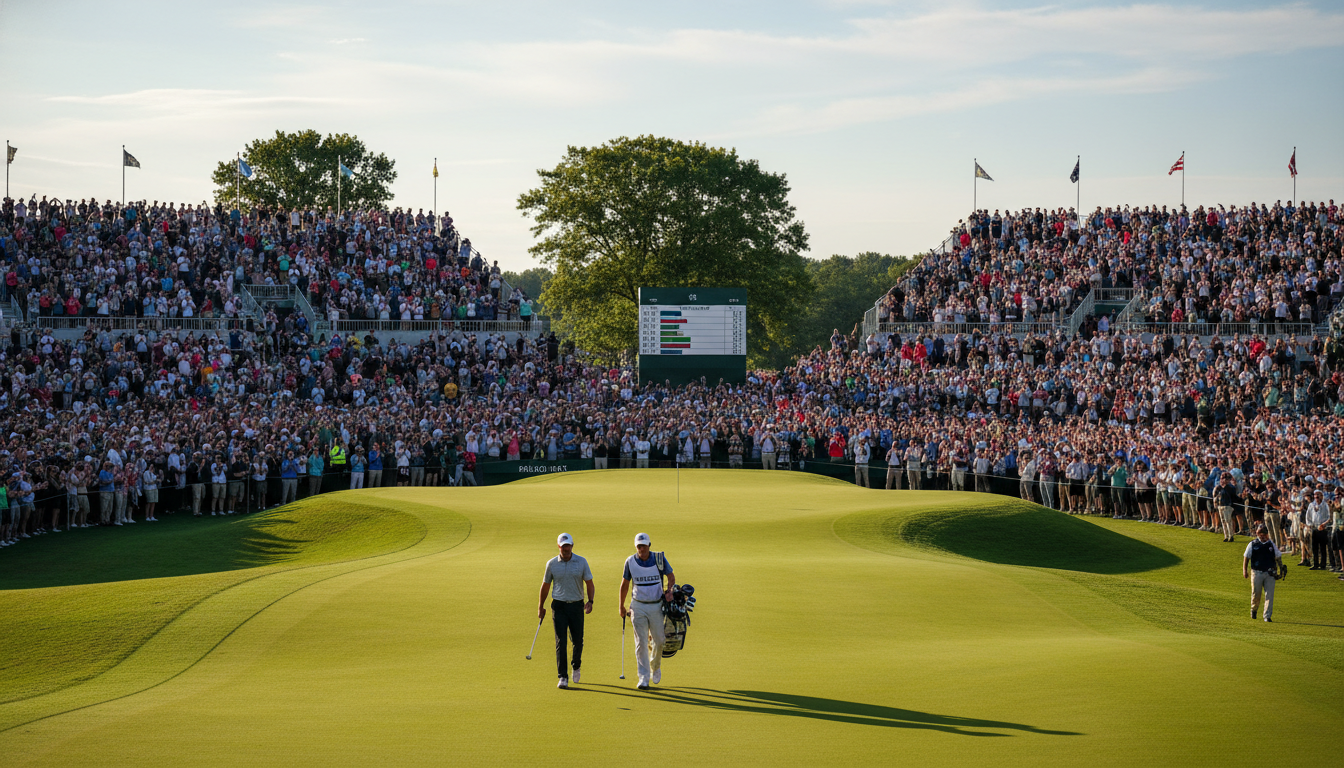


The AT&T Pebble Beach Pro-Am 2026 delivered exactly what the Wednesday preview predicted: elite approach players thrived through the early-week weather, and Friday’s calm conditions turned the leaderboard into a birdie fest. Now we’re staring at a wide-open weekend with Akshay Bhatia and Ryo Hisatsune sharing the lead at -15, but the real betting story is what the DataGolf model sees that FanDuel and DraftKings odds are missing.
With 25 players within five shots of the lead and Scottie Scheffler lurking at -9, the weekend setup favors ball-strikers who can navigate Pebble Beach’s small greens and avoid the coastal rough. The cut line fell at -1 (139 strokes), eliminating some pre-tournament favorites but keeping most contenders in play for Saturday’s moving day.
This Week’s Betting Landscape
The FanDuel and DraftKings boards show Akshay Bhatia as the favorite at +410, which translates to roughly 19.6% implied probability. The DataGolf model actually agrees here, pegging Bhatia at 15.3% to win, making this one of the rare spots where the favorite isn’t overbet. Rickie Fowler (+540) and Sam Burns (+530) round out the top three on most sportsbooks, both sitting at -14 after two rounds.
What’s fascinating is how the books are pricing the elite names who started slowly. Xander Schauffele sits at +2600 on bet365 despite being five shots back, while Scottie Scheffler is +2800 at Caesars from six shots behind. The DataGolf model gives Scheffler approximately 20.9% to win, suggesting those odds reflect significant value for one of the world’s best players.
The longshot market is where things get interesting. Min Woo Lee (+1650 at DraftKings) and Sepp Straka (+1400 at FanDuel) both sit at -12, and the DataGolf model sees Lee at 5.6% and Straka at 5.4% to win. Those numbers suggest reasonable value on both, though we’ll dig deeper into the model discrepancies shortly.
Value Plays: Where the DataGolf Model Disagrees
The biggest model-versus-market edge appears with Rory McIlroy, who’s priced at +2600 across most books despite sitting at -9 (six back). The DataGolf model assigns him approximately 4.1% win probability, which implies he should be closer to +2340. McIlroy’s strokes gained approach (0.412 over his last 50 rounds) doesn’t rank elite for this venue, and his recent form doesn’t justify the short price. The books are overvaluing his name recognition.
On the flip side, Jake Knapp at +2000 looks like a genuine model edge. The DataGolf model gives Knapp approximately 2.2% to win from -11, which implies fair odds around +4500. His 0.655 strokes gained approach over the last 50 rounds ranks inside the top 15 in the field, and he’s proven he can close on tough tracks. DraftKings has the best number at +2000, but this is a spot where the market offers significant value compared to the model.
The video above breaks down the pre-tournament betting angles for Pebble Beach, including strokes gained correlations that matter most this week. Key takeaway: approach play and putting on Poa annua separate contenders from pretenders.
The most glaring discrepancy sits with Hideki Matsuyama at +3200. The DataGolf model pegs him at approximately 2.0% to win, which implies odds closer to +4800. Matsuyama’s -0.085 strokes gained off-the-tee becomes a significant liability on a course where accuracy off the tee matters more than distance. His elite approach play (0.758 SG:APP) keeps him in the mix, but the model suggests he’s overvalued by roughly 35% compared to fair odds.
Matt Fitzpatrick at +3200 presents a more compelling case. The DataGolf model gives him approximately 2.0% to win, which translates to implied odds around +4900. This is significantly underpriced by the market, but Fitzpatrick’s all-around game (0.497 SG:APP, 0.333 SG:PUTT) profiles perfectly for Pebble Beach. His R1 66 and strong R2 put him at -10, and he’s shown he can navigate coastal conditions throughout his career.
Strokes Gained Breakdown for Pebble Beach
Approach play dominates the correlation matrix at Pebble Beach, with strokes gained approach accounting for roughly 45% of scoring variance over the past five years. The winning score typically comes from players gaining 1.5+ strokes per round on approach, which makes sense given Pebble’s tiny greens (averaging 4,500 square feet) and firm conditions.
Putting on Poa annua becomes the secondary separator. Players averaging +0.3 strokes gained putting or better have won four of the last six editions. The leaders reflect this pattern: Akshay Bhatia has gained strokes on approach in 14 straight measured rounds, while Sam Burns ranks top-10 in the field in both approach and putting over his last 50 rounds.
Off-the-tee accuracy matters more than distance here. The fairway width averages just 28 yards on Pebble’s tightest holes, and the coastal rough can turn a missed fairway into an instant bogey. Scottie Scheffler’s 0.916 SG:OTT leads the field, but his inability to gain ground Thursday and Friday suggests even elite drivers need perfection in these conditions. The model weights OTT at roughly 20% importance this week, compared to 45% for approach and 25% for putting.
Around-the-green play (ARG) typically accounts for 10% of the scoring variance, as Pebble’s small greens create constant short-game challenges. Hideki Matsuyama leads the field at 0.467 SG:ARG, which explains why he’s stayed in contention despite losing strokes off-the-tee. Players who can scramble effectively gain an extra half-stroke per round on the field.
R1/R2 Recap and Weekend Storylines
The AT&T Pebble Beach Pro-Am R1 recap highlighted Akshay Bhatia’s opening 65 at Pebble Beach that set the tone, followed by a near-flawless Friday that pushed him to -15. His ball-striking has been dialed in, and he’s avoided the big mistakes that typically derail contenders here. Ryo Hisatsune’s Thursday 62 at Spyglass Hill came out of nowhere, but his follow-up round proved it wasn’t a fluke. Hisatsune gained 3.2 strokes on approach Thursday and another 2.8 Friday, which is exactly the profile you want at Pebble.
Rickie Fowler (-14) continues his resurgence with consecutive rounds in the mid-60s. His familiarity with Pebble Beach (five top-10s in this event) makes him a legitimate threat, and the DataGolf model’s approximately 15.3% win probability reflects his strong course history. Sam Burns (-14) looked shaky Thursday at Spyglass but bounced back with elite iron play Friday, gaining over four strokes on approach across the two rounds.
The cut line at -1 eliminated several pre-tournament favorites who struggled with the coastal winds Thursday. The weekend setup now favors the leaders who’ve already proven they can score in these conditions. With Pebble Beach playing as the primary venue Saturday and Sunday, expect scoring to remain low if the weather cooperates.

Get the Edge on Every Tournament
AI-powered predictions, data-driven analysis, and expert picks delivered before every PGA Tour event.
Try Golf Agent ProMin Woo Lee (-12) put himself in position with strong approach work, though his putting remains a question mark. Jacob Bridgeman (-12) and Sepp Straka (-12) both sit five back, with Straka’s all-around consistency making him a sneaky top-5 candidate. Tom Hoge, Jake Knapp, and the -11 group are within striking distance if they can post 66 or better Saturday.
Matchup Analysis
The McIlroy vs Scheffler matchup at most books (McIlroy +156, Scheffler -205) looks like a Scheffler trap. The DataGolf model actually favors McIlroy at +201 vs Scheffler -201, suggesting the market has overreacted to Scheffler’s slow start. Both players sit at -9, but Scheffler’s elite strokes gained approach (1.25) should give him more upside than McIlroy’s pedestrian 0.412 SG:APP suggests. The model sees this as essentially a coin flip with slight Scheffler lean, while bet365 and Caesars are offering inflated Scheffler prices that don’t reflect the actual probability.
The Rose vs Kim matchup offers an interesting strokes gained contrast. Justin Rose profiles as the safer ball-striker with balanced gains across all categories, while Si Woo Kim’s elite approach play (0.964 SG:APP) gives him more tournament-winning upside. The DataGolf model slightly favors Kim at -121 vs Rose +121, which aligns with Kim’s stronger recent form. Rose’s experience at Pebble Beach (three top-10s) keeps this competitive, but Kim’s ceiling is higher if the putter cooperates.
Day vs Griffin represents a pure putting battle. Ben Griffin’s 0.434 strokes gained putting over his last 50 rounds dwarfs Jason Day’s inconsistent flatstick work. The DataGolf model essentially calls this even at +119 vs -119, but Griffin’s superior iron play (0.601 SG:APP vs Day’s 0.373) suggests he should be favored. If you can find Griffin at plus-money in this matchup on DraftKings or FanDuel, the model suggests value.
Key Stats to Watch This Weekend
Proximity from 150-175 yards becomes critical on Pebble Beach’s tiny greens. Players averaging under 25 feet from this range have historically gained 0.5+ strokes per round on the field. Saturday’s pin positions will favor those who can control trajectory in coastal winds, making this mid-iron range the key scoring separator.
Three-putt avoidance on Poa annua determines who survives the weekend pressure. The leaders have all avoided three-putts through two rounds, but Pebble’s Sunday greens (running 12+ on the stimpmeter) create disaster potential for players who get above the hole. Historical data shows players with three or more three-putts over the weekend finish an average of eight shots worse than those who avoid them entirely.
Bogey avoidance from 18-handicap or easier holes separates winners from top-10s. Pebble Beach has six holes playing under par this week, and the champions typically play those holes in a combined 6-under or better for the tournament. Players who make careless bogeys on the easy holes rarely contend Sunday, which is why course management becomes paramount.
Scrambling from 10-20 yards will test everyone’s short game, especially for those looking to master how to chip and pitch like a pro under pressure. Pebble’s small greens force constant up-and-downs, and players getting up-and-down at least 60% from this range gain an extra stroke per round. The coastal rough around the greens punishes offline shots, making clean contact around the greens essential for scoring.
Get the Full Breakdown
The model discrepancies highlighted here scratch the surface of what’s available for weekend betting decisions. For complete matchup analysis, model-driven picks, and round-by-round betting cards that adjust as conditions change, Golf Agent Pro provides the data-driven edge serious bettors need at every PGA Tour event.