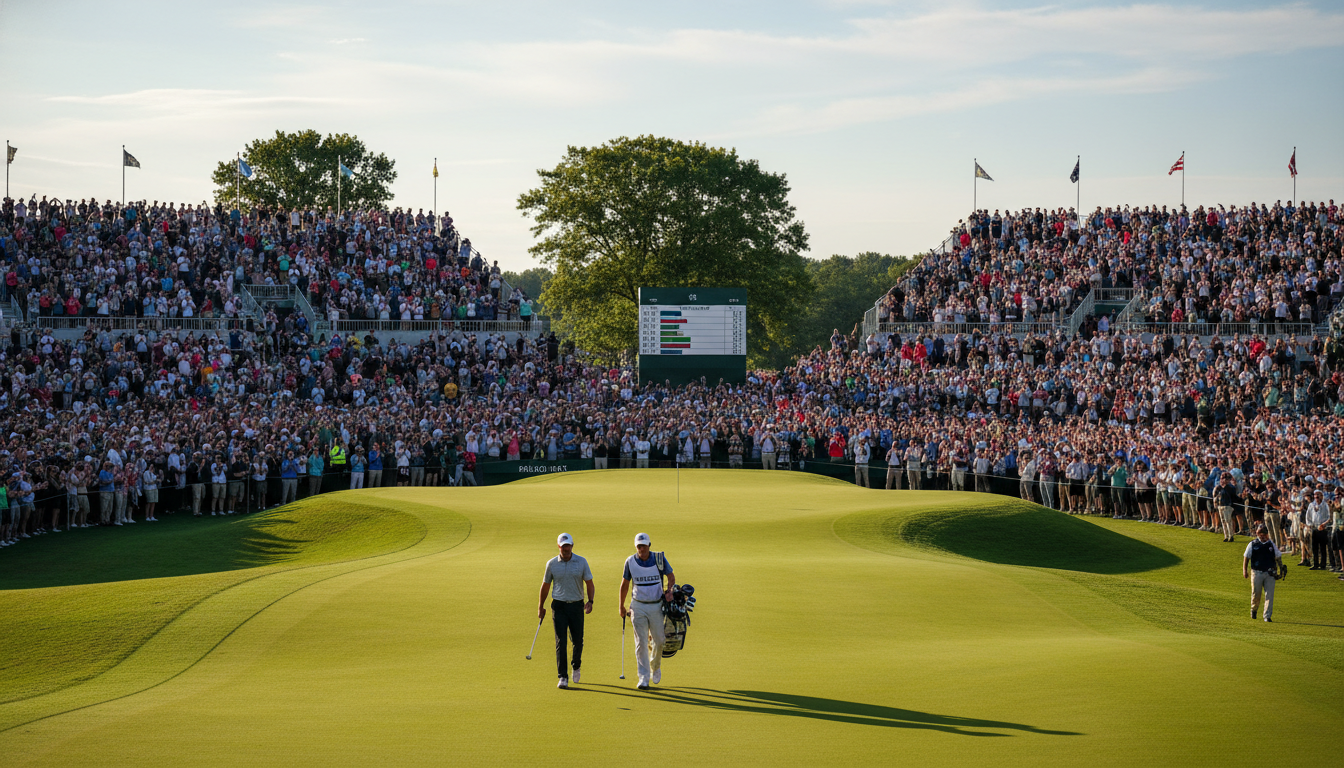

The WM Phoenix Open delivered exactly what we expected through two rounds: chaos, roars from the 16th hole, and a leaderboard that looks nothing like the pre-tournament odds board. Ryo Hisatsune’s stellar play has him atop the leaderboard at 11-under after a Friday 63, with Hideki Matsuyama one shot back at 10-under following rounds of 68-64. The real story for bettors is how dramatically the weekend odds have shifted compared to where the DataGolf model sees value. With several contenders positioned closely on the leaderboard, the tournament favorites landscape remains wide open heading into the weekend.
The cut line fell at 1-under par, eliminating several high-profile names and creating opportunities for those who survived the weekend. Our WM Phoenix Open 2026 preview highlighted the importance of approach play and wind management early in the week, and those factors played out exactly as expected with Thursday’s brutal conditions separating the field.
This Week’s Betting Landscape
Hisatsune leads at 11-under, with his odds ranging from +500 (FanDuel) to +598 (Pinnacle) reflecting his commanding one-shot advantage. Matsuyama sits in second at 10-under, with his +250 odds (matching across most books at +250 to +265) pricing him as the tournament favorite despite trailing by a stroke. The DataGolf baseline model is not available during live tournament play, but the history-fit model provides useful context for odds evaluation.
Chris Gotterup at +1000 (FanDuel/Betonline/Pointsbet) to +1100 (bet365/betmgm/betway/williamhill) presents an interesting case study in odds value after his opening 63-71 has him at 8-under and tied for third. Si Woo Kim continues to draw attention after a Friday 62 vaulted him to 7-under despite an opening 73, with his odds ranging from +1100 (bet365) to +1400 (betmgm/betway/bovada).
The longshot board shows significant variance, with players like Min Woo Lee at +4000 offering value for those seeking tournament winner tickets at longer prices. Michael Thorbjornsen represents the type of longshot where even small edges compound into meaningful expected value over a season of betting.
Value Plays: Where the Model Disagrees
The most interesting betting opportunities often emerge during live tournament play when books must rapidly adjust odds while players still have multiple rounds ahead. Chris Gotterup’s position at 8-under, tied for third and just three shots back, makes his +1000 to +1100 odds range worth consideration given his elite OTT numbers (0.694 SG:OTT) that match perfectly with TPC Scottsdale’s demands. His solid opening rounds have him positioned without the public attention that would typically compress these odds further.
Si Woo Kim’s dramatic Friday 62 showcases the volatility that makes him either a tournament winner or a missed-cut candidate. Now safely through to the weekend at 7-under, his range of +1100 to +1400 reflects the market’s uncertainty about his consistency. His approach game ranks among the field’s best (0.901 SG:APP), and Scottsdale’s poa annua greens have historically neutralized pure putting advantages, making his weak putting numbers (-0.215 SG:PUTT) less concerning here than at traditional venues.
This preview from Taft Gantt explores which player types thrive at TPC Scottsdale’s unique atmosphere and course setup. The key takeaway: elite ball-strikers with weak putting can compete here more than at traditional venues.
Maverick McNealy’s positioning in the tournament presents another potential edge, with his well-rounded game (0.417 SG:APP, 0.376 SG:PUTT) lacking any glaring weakness. McNealy has historically performed well in Phoenix, and the books may be overweighting recent poor form while undervaluing his skill set’s translation to Scottsdale’s demands.
On the flip side, Sahith Theegala’s odds around +1600 to +1800 likely reflect public betting action driven by his popularity and aggressive playing style. Matt Fitzpatrick’s positioning at +1800 to +2000 similarly may include some popularity premium, as casual bettors gravitate toward recognizable names regardless of current tournament position.
Ryo Hisatsune represents the most interesting case at the top of the leaderboard, with his +500 to +598 odds range reflecting his one-shot lead but also acknowledging his limited PGA Tour winning experience. His ball-striking through two rounds validates the performance as legitimate rather than fluky, but the pressure of protecting a 54-hole lead on Sunday at Scottsdale represents uncharted territory.
Strokes Gained Breakdown
TPC Scottsdale’s Stadium Course demands elite approach play above all else, and the leaderboard through two rounds confirms what the data suggested all week. The correlation between SG:APP and scoring average here runs higher than almost any non-major venue on tour. Matsuyama’s 0.711 SG:APP ranks 14th in this field, but his short game (0.426 SG:ARG) provides the scoring punch that pure approach merchants lack.
Si Woo Kim’s 0.901 SG:APP leads the realistic contenders and explains his model support despite pedestrian putting numbers. At a course where birdie-or-better percentage on par 4s determines winners, Kim’s ability to consistently hit greens in regulation and create looks inside 15 feet overrides putting concerns. The poa annua surfaces here aren’t lightning-fast bent grass, reducing the premium on elite putting strokes.
Off-the-tee play matters more than traditional scoring suggests because Scottsdale’s wide fairways mask the importance of angles. Chris Gotterup’s 0.694 SG:OTT gives him optimal approach angles, particularly on the short par 4s where aggressive lines create wedge opportunities. The difference between a 130-yard wedge and a 155-yard 9-iron is massive in expected birdie probability, and OTT performance dictates those distances.
Putting actually becomes less predictive here than at most venues, with the bumpy poa surfaces creating more variance per stroke than bent grass. Cameron Young’s 0.451 SG:PUTT advantage becomes less meaningful when players like Kim can neutralize it through superior approach proximity.
Matchup Analysis
The Schauffele vs Morikawa matchup shows DataGolf favoring Schauffele at -150, which aligns with Schauffele’s superior all-around game (1.655 SG:Total vs 1.198). Morikawa’s weak putting (-0.194 SG:PUTT) creates significant risk at a venue where he can’t fully leverage his elite ball-striking (0.755 SG:APP) without converting birdie opportunities. Schauffele’s consistency across all categories makes him the safer play, though Morikawa’s ceiling remains high if the putter cooperates.
Rodgers vs Straka offers a fascinating skill-set contrast, with DataGolf slightly favoring Rodgers at -111. Both players profile as steady rather than spectacular, but Rodgers’ recent form and comfort level at Scottsdale give him a marginal edge. Straka’s game lacks a defining strength that translates to Scottsdale’s birdie-fest requirements, while Rodgers can occasionally get hot with the putter and post a low number.
The Mitchell vs Kitayama matchup sits nearly even in the model (-108 vs +108), reflecting two players with similar ceiling/floor profiles. Mitchell’s slightly better approach numbers give him a razor-thin advantage, but this represents more of a stay-away matchup than a clear betting opportunity. When the model sees two players this close, the vig makes both sides negative expected value.

Get the Edge on Every Tournament
AI-powered predictions, data-driven analysis, and expert picks delivered before every PGA Tour event.
Try Golf Agent ProR1/R2 Recap and Weekend Storylines
Ryo Hisatsune’s opening 68-63 performance positions him as the outright leader at 11-under, with his ball-striking dominance in Friday’s second round showcasing the skill set that makes him dangerous despite limited PGA Tour experience. His iron play has been surgical, and while his putting hasn’t needed to be elite given the quality of looks he’s creating, the poa surfaces here don’t require perfection.
Hideki Matsuyama sits one shot back at 10-under after rounds of 68-64, his steady play through two rounds validating everything the model projected about his fit for this course. His approach play has been excellent, and his experience winning at this venue combined with his comfort level with Scottsdale’s crowds make him the betting favorite despite not holding the lead.
Chris Gotterup’s 63-71 start has him tied for third at 8-under alongside Pierceson Coody, who posted 66-68. Both players sit three shots back and very much in contention heading to the weekend. Gotterup’s elite ball-striking metrics support his performance as sustainable after his Sony Open victory earlier this season, while Coody continues to show the game that has made him one of the tour’s emerging talents.
The cut line at 1-under eliminated several pre-tournament contenders, creating chaos in the betting markets as recency bias pushes money toward players who performed well in R1/R2. Si Woo Kim’s Friday 62 after an opening 73 perfectly exemplifies his high-variance profile, and having made the weekend comfortably at 7-under, his blow-up risk is behind him.
This PGA Pro breakdown examines which contenders have the skill sets to post weekend 63s or 64s at Scottsdale. The main insight: aggressive players who can take advantage of short par 4s and reachable par 5s gain strokes in bunches here.
The weekend will likely require multiple 65s or better to win, meaning players sitting 3-4 shots back remain very live. Matt Fitzpatrick and Sahith Theegala both made comfortable cuts and position themselves within striking distance, exactly the scenario where their high-ceiling games become dangerous. Jake Knapp’s solid positioning continues his strong 2025-2026 season.
Key Stats to Watch
Birdie-or-better percentage on par 4s under 450 yards will separate weekend contenders from pretenders, as Scottsdale features multiple drivable or wedge-distance holes. Players averaging 4.5+ birdies per round typically contend here, and that requires elite approach proximity and solid putting on easier holes. Hisatsune’s opening rounds demonstrate the aggressive mindset needed.
Strokes Gained Approach from 100-150 yards becomes the single most predictive statistic for weekend success at TPC Scottsdale. The course sets up an unusual number of wedge approaches, and players who consistently hit these shots inside 15 feet create cascading birdie opportunities. Si Woo Kim and Hideki Matsuyama both rank elite in this specific proximity bucket.
Three-putt avoidance matters more than pure putting skill given poa annua’s bumpiness and the pressure of weekend crowds. Players who can two-putt from 30+ feet without stress will maintain position, while those forcing birdies and three-putting will slide down the leaderboard. The greens get trickier as weekend foot traffic increases, making conservative lag putting more valuable than aggressive birdie attempts from distance.
Scrambling from greenside bunkers will play a bigger role than typical weeks, as Scottsdale’s aggressive pin positions and firm greens create more short-sided situations. Players with elite bunkers games (Matsuyama’s 0.426 SG:ARG) can turn potential bogeys into pars and maintain momentum. One or two key scrambles in R3/R4 often determine the winner at courses where everyone is making birdies.
Get the Full Breakdown
This breakdown scratches the surface of the data-driven analysis available for weekend betting decisions. Check out our WM Phoenix Open 2026 model review to see how these picks played out. Golf Agent Pro provides complete betting cards with model-driven picks, detailed matchup analysis, and real-time odds comparisons for every PGA Tour event. Get the edges that casual bettors miss at Golf Agent Pro.